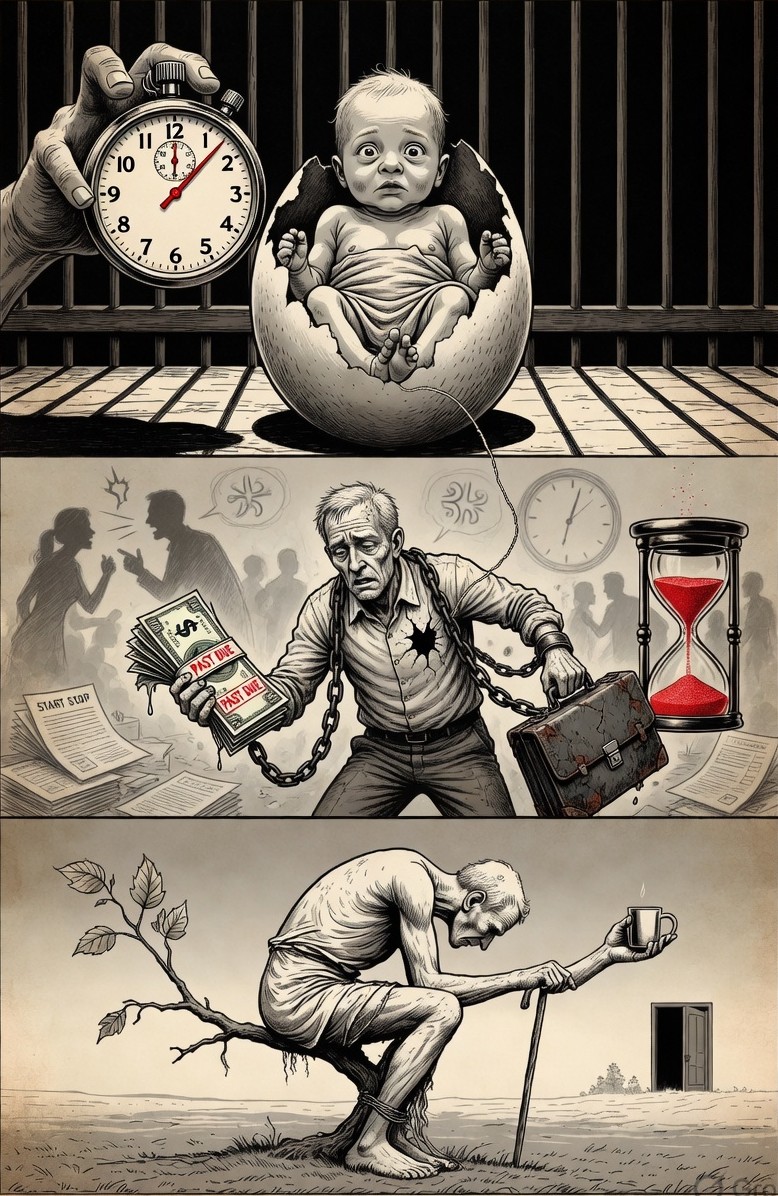
A Call to Compassion, Self-Reliance, and Spiritual Awakening
In today’s world, we often associate the term “Crisis Time” with accidents, financial collapse, or calamities—events that disrupt life and require urgent support. Of course, these are real crises, and in such moments, reaching out to help is both humane and a sacred act. But what if the idea of a crisis was much broader, and more deeply woven into the fabric of every human life? What if a crisis was not just a misfortune, but also those stages of life where one becomes physically, emotionally, or mentally dependent on others? Let me call this the Crisis Period
And so, life holds other, quieter forms of crisis—periods that we accept as natural, yet are deeply challenging. We speak rarely about them, and we prepare even less. But if we wish to live wisely and grow spiritually, we must learn to recognise these hidden crises and respond with both personal responsibility and collective compassion.
Childhood: The First Hidden Crisis
From birth through early adolescence, a child cannot survive without help. They rely entirely on their parents, elder siblings, or caregivers for every basic need—food, clothing, bathing, protection, and emotional support. Yet, we rarely label this period as a “crisis.”
This, too, is a Crisis time, a time of helplessness. However, because it is universal, we often fail to recognise it as a crisis. Yet a single lapse in care at this stage can mean lifelong consequences. But think again: if help is not given, the child cannot survive. Is this not the most vulnerable state of existence?
Childhood is not just a stage of growth—it is a sacred crisis wrapped in innocence. And it demands love, patience, and protection. And every helpless state calls for compassionate action from those who are strong.
Old Age: The Second Great Crisis
Then comes the mirror image of childhood—old age. From around 60 or 65 onward, the body begins to surrender. The limbs tire, vision fades, memory weakens, and the organs slow down. By the time one is 70 or 80, even the smallest daily tasks—such as bathing, dressing, and walking—can become a burden. Once again, one becomes dependent. Once again, one lives in a fragile, waiting world.
This, too, is a Crisis Period, a true crisis of physical limitation and emotional vulnerability. And it cries not only for physical support, but for dignity, empathy, and presence.
And yet, this stage is often overlooked, ridiculed, or abandoned in modern society, especially where speed and productivity are revered, and the slow are marginalised.
Just as the child needed help to rise, the elder needs help to remain standing.
The Cycle of Life: From Receiver to Giver and Back
If you are young, strong, and independent today, remember this: You, too, have been through a time of crisis—your childhood. You were once totally dependent on your parents. And you, too, will enter another time of crisis—your old age. You will once again need someone to care for you.
So, what is your duty today?
- To care for the children in your home and society—not just with money, but with love, presence, and guidance.
- To serve the elders—with dignity, not pity; with gratitude, not boredom.
Because the measure of a society’s spiritual health is not in its wealth or technology, but in how it treats its most vulnerable—its young and its old.
But Should We Always Depend on Others?
Here lies the spiritual turning point of this reflection.
In a fast-paced world where no one has time for anyone, there is great value in cultivating independence, not just physical, but emotional and spiritual. It is not selfish to prepare to die with your shoes on—it is noble.
Let us strive for what we may call a “walky-talky death”—a life where we remain:
- physically active as long as possible,
- mentally alert and free of complaints,
- spiritually strong, anchored in purpose and detachment,
- and emotionally self-contained, without imposing on others.
A “walky-talky death” is not about vanity—it is about grace.
It is about leaving the world upright, not burdening it in the end.
This, however, is not a guarantee, but a possibility—and one that requires:
- conscious lifestyle choices,
- inner discipline,
- and daily spiritual practice.
If That Fails — Let Compassion Prevail
Yet we must also acknowledge reality. The body may falter despite our best intentions. Illness, injury, or time may bring us to dependence. In such cases, our dignity depends not only on ourselves but on those around us.
Therefore, it becomes the sacred duty of the young, the strong, and the capable to care for:
- the weak and frail,
- the young and voiceless,
- the old and forgotten.
He who ignores the needy today may find himself ignored tomorrow.
The hands that support others in their crisis build their own refuge for the future.
The Cycle of Crisis and Service
Every strong adult was once a helpless child.
Every elder was once a provider for others.
And every young person today will one day feel the weight of time.
So if you received care as a child, repay it forward by serving your elders.
And if you are blessed with strength now, use it not to dominate, but to uplift.
Because your youth is a loan from life, it will be asked back one day.
The Spiritual Core: Seva and Sadhana
This balance of self-reliance and seva (service) is the mark of a complete human being.
- Strive to be independent through yoga, the right food, disciplined living, and inner surrender.
- But never hesitate to help those who can no longer stand without support.
- For when you help the helpless, you help the Divine hidden in them.
“Serve all beings as God, and God will serve you in your hour of need.”
– Spiritual Truth across all traditions
Spiritual Insight: Serving Others Is Serving God
In the great Indian spiritual tradition, seva (service) is not a charitable act—it is worship. To serve a hungry child is to feed God Himself. To help a frail elder walk is to hold the hand of the Divine.
“Seva Parmo Dharma” – Service is the highest religion.
“Daridra Narayan” – God dwells in the weak and the needy.
When you ignore the call to serve others in their crisis, you close the doors to the Divine in your life.
But when you serve selflessly, you cleanse your own heart and make it a worthy dwelling place for peace and grace.
Consequences of Neglect: The Law of Return
The universe operates according to the law of karma, which is a principle of cause and effect. If today you disregard the needs of others in their crisis—children, elders, the sick, or the vulnerable—then tomorrow, when your turn comes, you may find the world turning its back on you.
You may be left crying for help that never arrives.
You may feel the very pain you once ignored.
Do not plant the seeds of indifference—because they grow into trees of sorrow.
Plant seeds of compassion—and you will reap joy when you most need it.
Let’s Rethink What Crisis Truly Is
A time of crisis is not always dramatic—it can be silent, prolonged, and socially invisible.
Let us broaden our definition of “Crisis Time”. Let us awaken to our duty.
Ask yourself:
- Do I honour and support the elderly in my family, or neglect them?
- Do I engage with the younger ones with care and wisdom, or am I too distracted?
- Do I think of service as a burden, or as a blessing?
In Conclusion: Your Actions Shape Your Future
If you want a peaceful and supported old age, begin by offering peace and support now.
If you wish to walk the spiritual path, begin with simple selfless acts.
“He who serves the helpless, serves Me,” says the Divine.
The hands that help are holier than the lips that only pray.
Let your life be a sanctuary of compassion. Then even in your weakest hour, help will come from unexpected sources, for the universe never forgets a single act of selfless service.
Final Reflection: Prepare for Crisis, Prepare for Grace
Let us widen our understanding of crisis.
Let us strengthen ourselves physically, mentally, and spiritually to carry our own weight as long as we can.
And when that becomes impossible, may we be surrounded by hearts that have learned the joy of selfless service.
The ideal is to walk until our last breath, talking with clarity, dying without regret.
But the foundation of that ideal is built today through:
- self-effort,
- spiritual grounding, and
- compassionate living.
If we honour this path, our lives will not just end well—they will have meaning for those who come after us.