The big bang theory is the most accepted but is also a misunderstood one to some extent. A common misunderstanding is that it describes the origin of the universe. That’s not quite right. The big bang explains how the universe developed from a very tiny, dense state into what it is today. It doesn’t have any explanation about what initiated it. Neither can it tell what came before the big bang nor even what lies outside the universe.
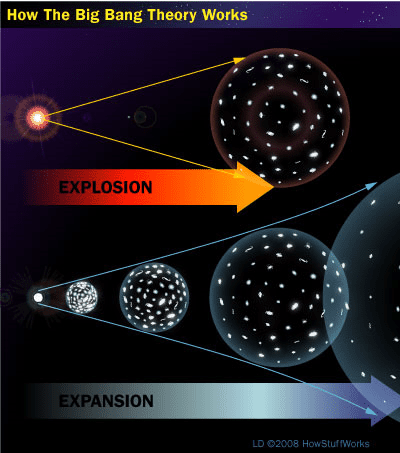
A misconception is that the big bang denotes a sort of explosion. That’s not true at all. It simply is an expansion of the universe. Though there are versions that suggest an incredibly rapid expansion (possibly faster than the speed of light), it’s still not an explosion in the real sense. Confusion about the big bang is partly due to its confusing name — it sounds like it should be an explosion. Blame that on Sir Fred Hoyle, a critic of the theory, who dismissively called the model a “big bang” as an insult. The derogatory comment caught on, and the name stuck.
Explaining the big bang theory, in a nutshell, is very much a challenge. Some concepts contradict the way we understand the world. The earliest stages of the big bang focus on a moment when all the separate forces of the universe existed compacted into a unified state. The further back you try to go back, the laws of science tend to break down. No scientific explanations can be given about what happened because science is inapplicable.
So what’s the big bang theory in a nutshell?
The first question itself is what a theory is? A theory in science is an attempt to explain a particular aspect of the universe. Theories can’t be proven, but they can be disproven. If observations and tests support a theory, it becomes stronger and finds acceptance amongst many scientists. If the evidence contradicts the theory, scientists must discard it or revise it in light of new evidence.
The Short and Skinny on the Big Bang
The big bang theory attempts to explain the universe’s development from when it came into existence until today. It’s one of several scientific models that attempts to explain why the universe is as it is. The theory makes several predictions, many of which stand proved through observational data. As a result, it’s the most popular and accepted theory regarding the development of our universe.
The most important aspect of the big bang is expansion. Many people think that the big bang is all about when all the matter and energy in the universe is concentrated at a tiny point. Then this point exploded, shooting matter across space, and the universe was born. The big bang explains the expansion of space itself, which means everything contained within space is moving apart from everything else. The following picture tries to illustrate the same. A picture at the end of the chapter explains the difference between explosion and expansion.
Today, when we look at the night sky, we see galaxies separated by what appears to be vast expanses of space. At the earliest moments of the big bang, all of the matter, energy and space we could observe were compressed to an area of zero volume and infinite density. Cosmologists call this a singularity.
What was the universe like at the beginning of the big bang? According to the theory, it was extremely dense and extremely hot. There was so much energy in the universe during those first few moments that matter as we know it couldn’t form. But the universe expanded rapidly, which means it became less dense and cooled down. As it expanded, matter began to form, and radiation began to lose energy. In only a few seconds, the universe started of a singularity that stretched across space.
One result of the big bang was the formation of the four fundamental forces in the universe. These forces are:
- Electromagnetism
- Strong nuclear force1
- Weak nuclear force
- Gravity
At the beginning of the big bang, these forces were all part of a unified force. It was only shortly after the big bang happened that the forces separated into what they are today. How these forces were once part of a unified whole is a mystery to scientists. Many physicists and cosmologists are still working out a Grand Unified Theory, which would explain how the four forces were once united and relate to one another.
Now let us look at where the big bang theory came from.
The First Second
Limitations of the laws of science preclude making any guesses about the moment the universe came into being. Instead, we can only look at the period immediately following the creation of the universe. Right now, the earliest moment scientists can talk about is 10-43seconds.
Cambridge University refers to the study of the the earliest moments of the universe as Quantum Cosmology. Application of classical physics is well neigh impossible at the earliest moments of the big bang as the universe was so small. Instead, Quantum Physics finds application. Quantum physics deals with physics on a subatomic scale. Much of the behaviour of particles on the quantum scale appears peculiar to classical physics. The link between quantum and classical physics alone can be more informative about how the universe works. At 10-43 seconds, the universe was tiny, dense and hot. This homogenous universe area spanned a region of only 1033 centimetres (3.9 x 10⁻³⁴ inches). The universe as of today spans billions of light-years. During this phase, according to big bang theorists matter and energy remained unified. All the four primary forces of the universe remained as a unified one. The temperature of the universe was very hot ( 1 x 1032 degrees Kelvin or 1 x 1032 degrees Celsius or 1.8 x 1032 degrees Fahrenheit). Soon, in no time, rapid expansion of the Universe took place, which came to be referred to as inflation. In less than a second, the universe doubled in size.
As the universe expanded, it also naturally started to cool down. There occurred decoupling of matter and energy at about 10-35 seconds. This came to be known as baryogenesis — baryonic matter is the kind of matter that becomes observable. Though not observable, existence of dark matter was assumable because it affects energy and other matter. During the period of baryogenesis, the universe was made of equiproportional matter and anti-matter. Infact, more matter than anti-matter. As most particles and antiparticles annihilated each other, some particles survived. All the matter of the Universe was formed by the combination of these particles.
The quantum age was followed by a period of quantum cosmology at 10-11 seconds. What happened at this time was something that could be recreated under laboratory conditions using particle accelerators, providing some observational data on the appearance of the universe. The unified force got split into its constituent components. The first to split off were the forces of electromagnetism and weak nuclear force. The universe was still too dense and photons outnumbered matter particles.
At about 0.01 seconds after the beginning of the big bang, came the period of standard cosmology. It is from here scientists could guage to a great extent of how the universe evolved. Expansion and cooling of the universe continued and the particles formed during baryogenesis started bonding together and neutrons and protons took shape. By one second after the big bang nuclei of light elements like hydrogen (in the form of its isotope, deuterium), helium and lithium appeared, in a process called nucleosynthesis. The condition of the universe being still too dense and hot, time was not ripe enough for electron to join with the nuclei to form stable atoms.