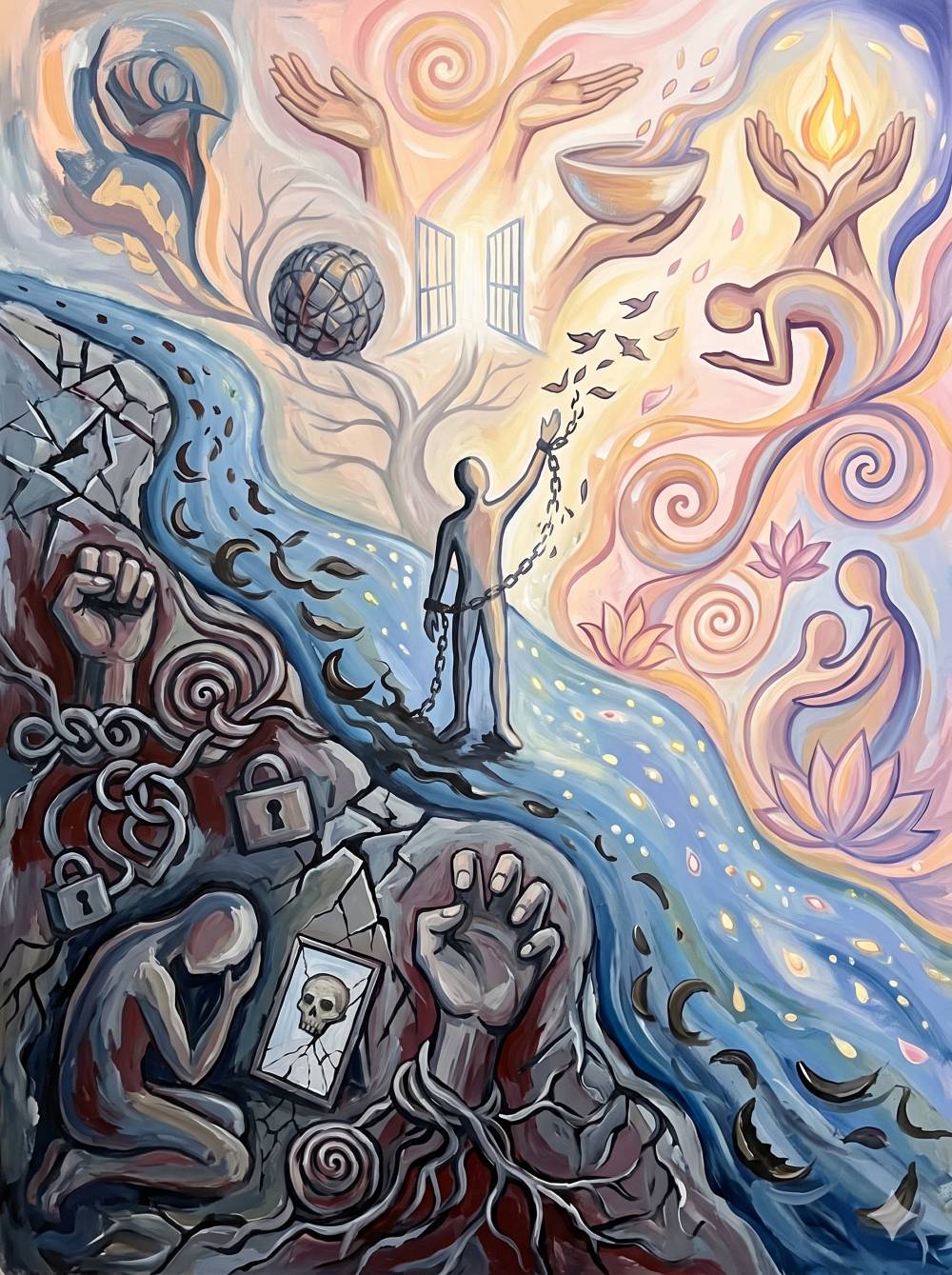
In every human life, two invisible currents are constantly flowing—one of selfishness and one of selflessness. Most people drift along with the current of self-interest, seeking wealth, comfort, status, and personal gain. And while this may bring fleeting success, it rarely brings true peace or inner joy.
But there is another current—a divine one—that few dare to enter. It is the stream of selfless service, compassion, and noble action. Those who walk this path, even for a short while each day, experience something extraordinary—a joy untouched by material possession, a peace not dependent on external comfort, and a fearlessness that only divine grace can bestow.
“Tyāgenaike amṛtatvam ānaśuḥ” — Only through selflessness is immortality attained.
(Isha Upanishad, 1.2)
What Happens When You Flow Only With Self-Interest?
If you live your entire life only for yourself, you may accumulate property, fame, or followers. But your soul will remain thirsty, your heart restless, and your mind clouded. True fulfilment always evades those who seek only for themselves.
Even animals, birds, and trees work for themselves. The sparrow builds its nest, the lion hunts its prey, and the tree draws nourishment from the soil. But they also offer something in return—the cow gives milk, the tree offers shade and fruit, even the river flows for the benefit of all.
If you, the human being—the citadel of creation, gifted with free will and intellect—do nothing for others, then in what way are you higher than animals?
Spiritual Power of Selfless Action
The Bhagavad Gita reminds us:
“Yajñārthāt karmaṇo’nyatra loko’yaṁ karma-bandhanaḥ”
“Selfless action, performed as an offering, frees one from bondage; selfish action binds the soul.”
(Gita 3.9)
Even just 30 minutes to an hour of selfless work daily—helping someone in need, feeding the hungry, mentoring a child, or even offering a kind word—can transform your spiritual frequency. You begin to feel energised, inspired, light, and inwardly guided.
Because when you serve others without expectation, you serve God Himself.
The Tragedy of False Pride and Mental Rigidity
Unfortunately, another current that flows strongly in society is the stream of ego and false wisdom. Most people believe they are intelligent, often more so than others. Even if they outwardly claim to be fools, inwardly, they carry the weight of pride. This leads to an unwillingness to accept better advice, especially when it comes from someone more spiritually or intellectually evolved.
How often do children reject the advice of their parents?
How many students resist the wisdom of their teachers?
How many disciples ignore the words of their gurus?
And even more tragically, when a wise teacher or saint is alive, people often ignore or doubt their teachings, even as they praise them publicly. But once that soul departs the world, they sing songs, hold memorials, print calendars, and organise commemorations—without actually following their teachings.
This is spiritual hypocrisy—an imitation of reverence without transformation.
Learning From the Lives of the Great
This has been the story of many spiritually realised souls—from Krishna to Christ, from Buddha to Mahavira, from Guru Nanak to Swami Vivekananda. While they lived, many questioned, mocked, or disbelieved them. But after they departed, the world tried to own their name—while ignoring their message.
“The prophet is without honour in his own town.” – Bible
This is a profound and timeless insight into human psychology and social behaviour, and it carries a spiritual warning that applies across cultures and religions.
Origin of the Phrase:
This line comes from the Bible, specifically from the teachings of Jesus Christ in the New Testament (Mark 6:4):
“A prophet is not without honour, except in his own country, and among his own kin, and in his own house.”
It refers to how those who are spiritually elevated or possess deep wisdom are often disregarded, doubted, or dishonoured by the very people who are closest to them—their family, friends, neighbours, or community.
Essence and Meaning:
When a prophet or saint arises from within a community, people around him see him as just another ordinary person. They remember his childhood mistakes, his human side, or his humble background. Due to familiarity, they fail to recognise the divine transformation that has occurred within him.
In contrast, strangers or outsiders, who approach with fresh eyes and reverence, are more open to the truth and receive the full benefit of the prophet’s wisdom.
Why Does This Happen?
- Familiarity breeds contempt – People tend to undervalue what is easily accessible or close to them.
- Ego and comparison – Others may feel challenged, envious, or unwilling to accept that someone from their own circle has risen so high.
- Judgment based on the past – They fixate on the person’s earlier, unpolished version and are unable to accept their spiritual evolution.
- Attachment to false authority – Society often respects position or title more than inner purity or wisdom.
“जाने के बाद कीमत जानी जाती है।” “Jaane ke baad keemat jaani jaati hai.”– Indian proverb
Meaning:The value is recognised only after someone is gone.
This proverb reflects a profound truth about human nature—people often fail to appreciate the worth, wisdom, or presence of someone while they are alive or in their presence. It’s only after they are no longer accessible—through death, separation, or departure—that their importance is truly felt.
Spiritual Insight:
This applies especially to saints, parents, teachers, and guides. While they are present, their words are often taken lightly. But once they leave, people realise the depth of their wisdom—and often regret not listening or learning when they had the chance.
It is a call for timely awareness, gratitude, and humility.
So, What Should You Do?
If someone in your life—your parent, teacher, mentor, or spiritual guide—genuinely lives with dharma, compassion, and deep wisdom, then don’t wait until it’s too late. Learn from them. Apply their teachings. Walk beside them while you can.
Otherwise, you too will fall into the pattern of the world—singing songs of saints long gone, while ignoring the sages walking beside you.
Time for Self-Reflection: Are You Truly Human?
Ask yourself today:
- Am I doing anything for others without expecting returns?
- Do I believe myself wise while ignoring wiser voices?
- Do I really walk the talk of my spiritual heroes, or just repeat their names?
Because if you live only for yourself, you are no different from a tree or an ox.
If you do not rise to serve, despite having freedom, knowledge, and opportunity, you may even fall below the level of animals, who serve nature by design.
परोपकारः पुण्याय, पापाय परपीडनम्। “Paropakāraḥ punyaaya, pāpaaya parapīdanam”
Helping others is a virtue; hurting others is a sin. Helping others leads to merit (punya); harming others leads to sin (paap).
This timeless aphorism from Indian wisdom beautifully encapsulates the moral foundation of Dharma.
- Paropakāra (परोपकार) means acts of kindness, service, and benefit to others—whether through charity, support, compassion, or guidance. Such actions purify the heart, uplift society, and draw divine grace. They are the source of punya—spiritual merit that elevates the soul.
- Parapīḍanam (परपीडनम्) means causing pain, harm, or distress to others, whether physically, mentally, emotionally, or even through negligence or selfishness. Such actions distort the soul, bind one in karmic debt, and lead to paap—sin, suffering, and spiritual downfall.
Essence:
“Your merit is not in how much you gain, but in how much you give.
Your sin is not in what you lack, but in the pain you cause others.”
This line serves as a moral compass and a spiritual reminder that our actions towards others shape our destiny, both in this life and beyond.
Conclusion: Flow With the Higher Current
You were not born just to earn, eat, and exit. You were born to evolve.
Let your life be a mixture of wise self-effort and heartfelt service. Be willing to receive advice humbly from those wiser than you. Reflect deeply on your conduct and motives. Refuse to be swept away by ego or selfishness.
And most of all, don’t wait for death to recognise the wisdom that stood right before you.
Learn from the living wise.
Live in service.
Grow in wisdom.
Then, your life will not only be successful—it will be sacred.