Nurturing Resilient, Compassionate, and Life-Ready Youth Through Cultural Education
In every age, education has meant more than reading, writing, and examinations. It has meant more than literacy and career preparation. True education shapes the whole human being — body, mind, heart, and soul. Yet in our modern, material-driven life, we have narrowed the meaning of extra-curricular or cultural activities to little more than dancing, singing, and occasional plays. While these have their place, they represent barely 10–20% of what a cultural programme should be. The remaining 80% — which develops character, resilience, service-mindedness, and God-consciousness — is often absent. Without it, children grow up knowledgeable yet spiritually unprepared for life’s challenges.
The result?
Our children grow up with knowledge, but without wisdom. They may know how to use a computer, but not how to control anger. They may excel in academics, yet collapse emotionally under life’s smallest setbacks.
Why This Is Dangerous
In the absence of deeper cultural and moral training:
- Sahan Shakti (endurance) is vanishing. Many youths panic over small failures.
- Exposure to media often normalises violence, murder, or suicide as ‘solutions’ to problems.
- Qualities like humility, compassion, generosity, and service are fading.
A society that neglects these foundations produces not just incomplete citizens, but fragile souls.
When Culture Loses Its Soul
A cultural programme without values is like a lamp without oil — it looks decorative but cannot give light. The ancients knew this truth well:
संस्कृति रक्षति रक्षितः (Sanskṛti Rakṣati Rakṣitā)
“Culture protects those who protect it.”
When we preserve and practice the principles of our culture — truth, compassion, service, discipline — they in turn protect us from moral decline, emotional breakdown, and social disintegration.
Today, many youths lack endurance (sahan shakti). Even small setbacks make them panic. Popular media often glorifies violence or self-harm as solutions. Without the protective armour of cultural values, their emotional strength collapses under pressure.
Sanātana Dharma’s Vision of Cultural Education
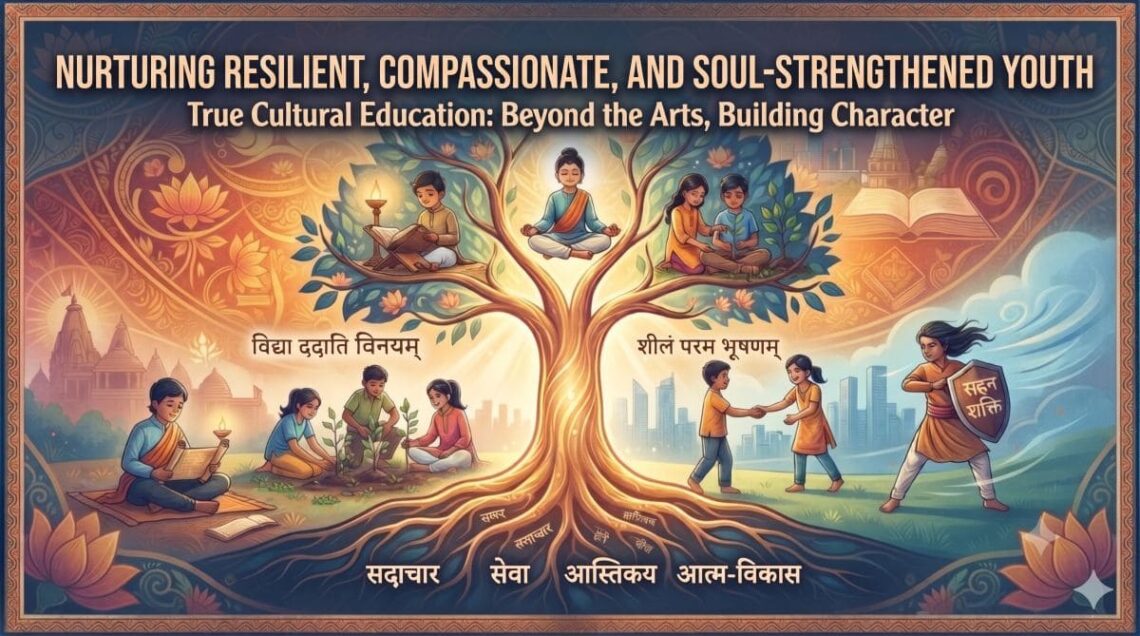
In the Sanātana Dharma tradition, culture (sanskriti) is not limited to the arts; it is the refinement of the whole being. The Vedas, Upanishads, and epics like the Mahabharata and Ramayana have always emphasised four pillars in shaping a child:
- Āstikya — faith in a higher reality, trust in Dharma.
- Sadāchāra — living by ethical principles.
- Sevā & Paropakāra — service to others and selflessness.
- Atma-vikas — inner self-development, mastery over mind and senses.
As the Bhagavad Gita (6.5) says:
“Let a man lift himself by his own self alone, let him not lower himself; for the Self alone is his friend, and the Self alone is his enemy.”
Sanātana Dharma’s Definition of Education
For our rishis, education was never about filling the mind with information; it was about transforming the person.
सा विद्या या विमुक्तये (Sā Vidyā Yā Vimuktaye) — Vishnu Purana 1.19.41
“That alone is knowledge which leads to liberation.”
Liberation here does not mean renouncing the world in childhood — it means freeing oneself from ignorance, harmful desires, and inner weakness, so that the soul can shine in its full potential. This is what cultural programmes should aim to do.
What True Cultural Programmes Should Include
If our cultural programmes are to live up to their name, they must include training in:
- Self-discipline and moral courage (learning to say “No” to wrong).
- Control over inner enemies — kāma (lust), krodha (anger), lobha (greed), moha (delusion), mada (pride), mātsarya (envy).
- Yoga and meditation for mental stability and focus.
- Service projects — feeding the needy, tree planting, and cleanliness drives.
- Storytelling from our epics — learning problem-solving and resilience from Rama, Krishna, Prahlada, Dhruva, and others.
- Simple living, high thinking — as practised by saints and sages.
The Missing 80%
If our cultural activities are to truly enrich children, they must include:
- Moral discipline and courage — the ability to resist peer pressure and say “No” to wrong.
- Training in self-control over lust, anger, greed, delusion, pride, and envy (ṣaḍripu).
- Yoga and meditation for focus and mental stability.
- Sevā and Paropakāra — service to others without expectation.
- Character-building stories from the Ramayana, Mahabharata, and Puranas.
As the Mahabharata declares:
शीलं परम भूषणम् (Śīlam Param Bhūṣaṇam)
“Character is the supreme ornament.”
A person may have degrees, wealth, and talent, but without character, these become dangerous weapons in the wrong hands.
What the Epics Teach Us
Stories That Shape Character
- Prahlada’s Faith: Even as a child under the threat of death from his own father, Prahlada never abandoned devotion to Narayana. His life teaches steadfastness in Dharma under pressure.
- Ekalavya’s Dedication: Though denied formal training, Ekalavya’s devotion to learning archery made him excel beyond all students. But his readiness to give even his thumb as guru-dakshina shows humility and obedience.
- Sri Rama’s Endurance: In 14 years of exile, Rama faced loss, war, and separation, yet stood as the ideal of patience, duty, and righteousness.
Such stories do more than entertain — they become moral compasses for life.
Parents, Teachers, and the Education System Must Unite
It is the joint duty of parents, teachers, and educational institutions to:
- Integrate value-based training into school activities.
- Provide opportunities for real-life problem solving — not just theoretical knowledge.
- Teach children spiritual practices that help them face stress without fear.
- Develop self-reliance, patriotism, and God-consciousness alongside academic excellence.
As Swami Vivekananda said:
“We want that education by which character is formed, strength of mind is increased, the intellect is expanded, and by which one can stand on one’s own feet.”
We must integrate value-based training into every cultural activity. This is not optional — it is the backbone of national and spiritual strength.
As the Manusmṛti says:
धर्मो रक्षति रक्षितः (Dharmo Rakṣati Rakṣitah)
“Dharma protects those who uphold it.”
If we fail to pass Dharma to our children, we not only weaken them individually, but we also weaken the entire social fabric.
The Goal of Education
The ultimate aim is captured in a simple but profound truth:
विद्या ददाति विनयम् (Vidya Dadāti Vinayam) — Hitopadesha
“True knowledge gives humility.”
When children learn humility, service, and self-mastery alongside their academics, they gain both success in the world and peace in the soul. Then they will not just survive in a materialistic world — they will lead it with wisdom.
The Vision Forward
Our children must grow into men and women who:
- Stand for truth (Satyam),
- Serve without expectation (Sevā),
- Bear hardship with courage (Sahan Shakti),
- And seek the Eternal (Moksha).
When cultural programmes once again reflect these timeless principles, we will not just produce achievers — we will nurture awakened souls who can live joyfully and guide society in the right direction.
As the Rigveda prays:
आ नो भद्राः क्रतवो यन्तु विश्वतः (Ā No Bhadrāḥ Kratavo Yantu Viśvataḥ)
“Let noble thoughts come to us from every side.”
In the words of the Yajurveda (31.18):
“By knowing Him alone, one overcomes death; there is no other way to be freed.”
This is the heart of cultural education — to fill our children’s minds with noble thoughts, their hearts with noble feelings, and their lives with noble actions — to lead a child from information to transformation, from success to significance, and finally, from self to the Self.
.