“The soul’s journey is not to linger as a shadow, but to rise like light toward the eternal.”
In today’s world, many people are confused about what happens after death. Some believe that the soul moves on quickly to a new birth. Others say that the soul lingers as a ghost or spirit and can be contacted. Still others perform rituals to “feed” or “appease” dead ancestors.
In today’s spiritual discussions, many people wonder:
- Do souls of the departed still linger?
- Is post-death communication possible?
- What is the true meaning of śrāddha (श्राद्ध)?
So, what is the truth? Let us explore these questions through the lens of the Bhagavad Gita, Vedic wisdom, and evolving traditions, as we seek a coherent spiritual understanding — and separate what is the eternal truth from what became later ritual or misunderstanding
1. The Gita’s View on the Eternal Soul
In the Bhagavad Gita 2.22, Lord Krishna declares:
“Just as a person gives up old garments and takes new ones,
So does the soul give up worn bodies and take new births.”
(vasāṃsi jīrṇāni yathā vihāya, navāni gṛhṇāti naro ’parāṇi)
This forms the foundation of the Indic doctrine of reincarnation — the soul (Jiva) is eternal, but takes repeated births according to karma and samskāras. The soul does not rest in disembodied limbo indefinitely. Rather, after death, it quickly or eventually takes another body, unless it has attained moksha (liberation/salvation) or has an exceptional fate.
The key ideas here are:
- The soul is immortal and indestructible.
- After physical death, it takes on another body suitable to its karmic balance and inner tendencies.
- The transition between two births is usually not meant to be long unless karmically destined.
- There may be a temporary sojourn in subtle realms (pitṛ loka, preta yoni), but rebirth is inevitable unless liberation is attained.
- Resting in the “pitṛ loka” or other subtle realms may happen temporarily, depending on karma, spiritual evolution, or unfulfilled desires.
The Gita does not describe endless lingering of disembodied spirits; it emphasises movement through the cycle of birth and death.
2. Vedic Śrāddha: Not a Ritual, But Reverence
I am touching upon an important and often misunderstood aspect of Śrāddha in the context of Vedic versus post-Vedic practices. Let’s unpack this carefully and fairly, grounding it in scriptural sources, Vedic reasoning, and spiritual insight — while acknowledging diverse traditions that have evolved over time.
Many believe that śrāddha means feeding the dead. But that is a misunderstanding.
The word śrāddha is derived from “śraddhā”, meaning faith, reverence, and devotion. In the early Vedic context, the essence of śrāddha is:
“Serving one’s parents and ancestors with love, faith, and a sense of duty — especially when they are alive.”
Original Vedic Emphasis:
So, yes, the original Vedic śrāddha was not focused on post-death ritualism, but rather on living dharma with reverence toward one’s lineage and elders.
In the Ṛigveda and Atharvaveda, there is very little emphasis on elaborate rituals for the dead. Rather, the emphasis is:
- On truthful living, dutiful service, and
- Caring for parents and elders as divine embodiments
- Instead, the Upanishads teach:
- Mātṛ devo bhava, pitṛ devo bhava — “Regard your mother and father as divine.”
- Serve them while they live, not with posthumous fear-based rituals.
3. Later Ritualistic Śrāddha (Post-Vedic/Smriti Era): A Cultural Evolution
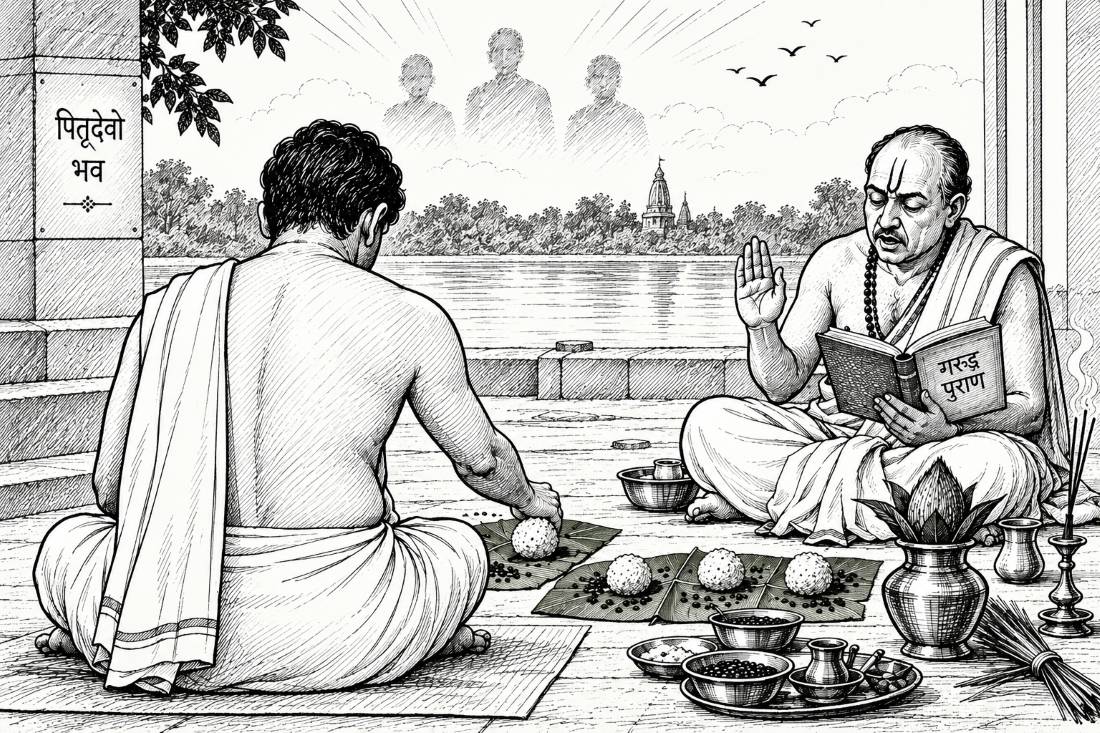
Over time, especially in the Smriti texts, Gṛhya Sūtras, Dharmaśāstra, and Purāṇic texts, the concept of śrāddha expanded into formal death rituals and posthumous offerings — such as:
- Piṇḍa dāna (offering balls of rice)
- Tarpana (libation of water)
- Invoking pitṛs (ancestral spirits) during specific lunar phases like Pitṛ pakṣa.
These rituals were believed to:
- Aid the soul’s transition
- Express gratitude to ancestors
- Bring closure to the living
These were said to:
- Provide satisfaction or upliftment to the departed soul.
- Remove obstacles in their journey to the next birth.
- Express gratitude to one’s lineage.
But here is the key question:
Do disembodied spirits actually need food or water?
- According to Vedantic and Yogic thought, no. The soul, when separated from the body, does not experience physical hunger or thirst. The offerings are symbolic, and their true efficacy lies in the faith and intent (śraddhā) of the person making them — not the material act itself.
4. Why the Vedas Focus on the Living, Not the Dead
Spiritual logic of the Vedas:
- Serve your parents while they are alive.
- Express gratitude while it matters.
- Do not rely on rituals to replace your duties.
This is echoed in various Upanishadic and yogic teachings:
- “Dead rituals done without real devotion are meaningless.”
- The soul moves on, guided by karma and consciousness. Rituals do not control their destiny unless supported by genuine spiritual merit.
5. Why Did Rituals Develop Then?
There are a few reasons:
- To give closure to the living: Death rituals help families process grief and honour their departed.
- To remind the living of their duties: Symbolic acts preserve ancestral memory and humility.
- To institutionalise gratitude and continuity: It kept the family lineage and tradition alive.
However, over time, many of these rituals lost their essence and became mechanical or superstitious, performed out of fear or social obligation, which the Vedas do not support.
6. The True Śrāddha: A Spiritual Reclaiming
To return to truth, we must reclaim the inner meaning of śrāddha:
✅ Serve parents with humility and love while they are alive.
✅ Honour the memory of departed ancestors with gratitude — not out of fear, but with understanding.
✅ Let go of superstition — no soul is “trapped” because we did not feed it rice balls.
✅ Help the soul most by doing truthful actions, charity, japa, or spiritual practice in their name.
Conclusion: Vedic Wisdom Over Ritual Formalism
True śrāddha is service with faith, not ritual alone. Vedic teachings, especially those echoed in the Gītā and Upanishads, emphasise karma, jnāna, and bhakti — not appeasing ghosts or feeding spirits.
The soul, guided by its karma, does not hunger for rice and ghee — it hungers for liberation.
“Feeding the living is greater than feeding the dead. Loving the present is holier than mourning the past.”
8. Psychic/Spiritual Healers and Spirit Communication
Many spiritual healers, mediums, and channellers speak of:
- Talking to departed ancestors or loved ones.
- The presence of spirit guides or discarnate beings offering help or wisdom.
- Souls lingering around due to unfinished business, emotional attachment, sudden or violent death, or even voluntary choice.
These ideas are common across spiritual traditions. Many modern traditions — including Western New Age mysticism, shamanic, and psychic practices often use terms like “crossing over”, “trapped spirits”, or “higher guides”.
They speak of:
- Departed souls lingering due to trauma, attachment, or unfinished karma.
- Spirit guides and ancestral beings communicating with the living.
How Does Vedic Thought Address This?
Indic tradition does acknowledge disembodied existence — but only temporarily:
- Preta yoni: After death, especially if death was sudden, the soul may temporarily enter a subtle or ghost-like state called preta, especially if there are unresolved desires, violent death, or improper rites. This is why śrāddha and piṇḍa-dāna rituals exist: to help these souls transition peacefully into the next life.
- Pitṛ loka: Righteous ancestors, if not reborn yet, may reside in ancestral realms for a while before taking a new birth. One can communicate or remember them during Pitṛ paksha.
- Bhūta-yoni and yakṣa/deva realms: Certain subtle beings, with or without gross bodies, exist — not all are reborn immediately. Some highly evolved beings may delay their rebirth for the purpose of service or as guides.
Thus, temporary contact with discarnate souls is possible, but the Indic view insists that this is not their final state — they must take rebirth unless liberated.
But this is not the final destiny.
As per the Gita and Vedas:
Every soul must move on — either toward rebirth or liberation.
9. True Guidance Comes from…
What about “spirit guides”?
In Indic systems, true spiritual guidance comes not from wandering spirits but from:
- Iṣṭa-devatā (personal deity)
- SadGuru (realised teacher)
- Devas, Ṛṣis, Siddhas, or other evolved souls
- Inner Self or Antaryāmin (the indwelling Lord)
So, what some call “spirit guides” may correspond to divine intelligences, ancestral protectors, or karmic beings temporarily aiding a soul — but not necessarily aimless ghosts wandering forever. The source must always be discerned carefully.
What some call “spirit guides” may be interpreted in the Indic context as ancestral protectors, karmic companions, or divine aides — but not aimless ghosts lingering forever.
10. Synthesis and Discernment
We can reconcile both views with discernment and spiritual maturity:
- Yes, souls do take rebirth, as stated by Krishna — this is the core truth of the karmic cycle.
- Yes, in exceptional situations, a soul may remain temporarily disembodied — due to intense attachment, traumatic death, or spiritual evolution.
- Yes, communication with such beings is possible but not ideal or encouraged, unless done with reverence, discernment, and spiritual purity.
- No, the soul does not endlessly remain in spirit form — that would violate the natural flow of karma and rebirth. The soul’s journey is inward and upward.
Final Reflection
- “The soul’s journey is not to hover as a shadow, but to rise like light toward the eternal.”
- Use discernment. Honour the scriptures. Keep the heart open, but the mind clear.
11. Conclusion: Reclaiming Śrāddha with Clarity
Let us return to the heart of śrāddha:
- Serve your parents with love, while they live.
- Honour your ancestors with inner purity, not mechanical rites.
- Let go of fear and superstition — no soul waits for rice balls.
- Liberate your ancestors through your own truth, virtue, and spiritual merit.
“Feeding the hungry now is greater than feeding the dead.
Loving in the present is holier than mourning the past.”
Final Word:
True Śrāddha is not in food for the dead — but in faith for the living, and freedom for the soul.
Let rituals be meaningful, but let understanding be deeper.
10. Final Synthesis: What Is the Soul’s True Path?
✔️ Yes — souls do take new births, according to karma.
✔️ Yes — some may temporarily stay in subtle states.
✔️ Yes — communication may be possible in rare, special cases.
❌ No — souls do not remain as ghosts forever.
❌ No — rituals alone do not determine their fate.
The goal of the soul is not to linger, but to return to the Supreme Self (Paramatma) through:
- Detachment from worldly desires
- Purification through good karma and devotion
- Grace of God or Sadguru
- Inner spiritual awakening
Conclusion: A Call to Clear Thinking and True Feeling
“Feeding the living is greater than feeding the dead.
Loving in the present is holier than mourning the past.”
Let us return to the true spirit of Vedic Dharma — which is not fear of spirits, but freedom for the soul.