In Hinduism, time is viewed not in years or centuries, but in vast cosmic cycles called Yugas and Kalpas, each spanning millions of years. Within this grand vision of time, a few rare souls are believed to have been granted the boon of immortality — not in the physical, eternal sense, but in the form of Chiranjeevitva, meaning life until the end of the current cosmic age.
These immortal beings are called Chiranjivis (from chiram = long, and jivi = life). Their presence is believed to uphold dharma (righteousness), guide humanity, and serve as witnesses to the ever-changing world. According to Hindu tradition, there are eight such Chiranjivis.
Let’s explore each of them, their life stories, and the reasons behind their long existence.
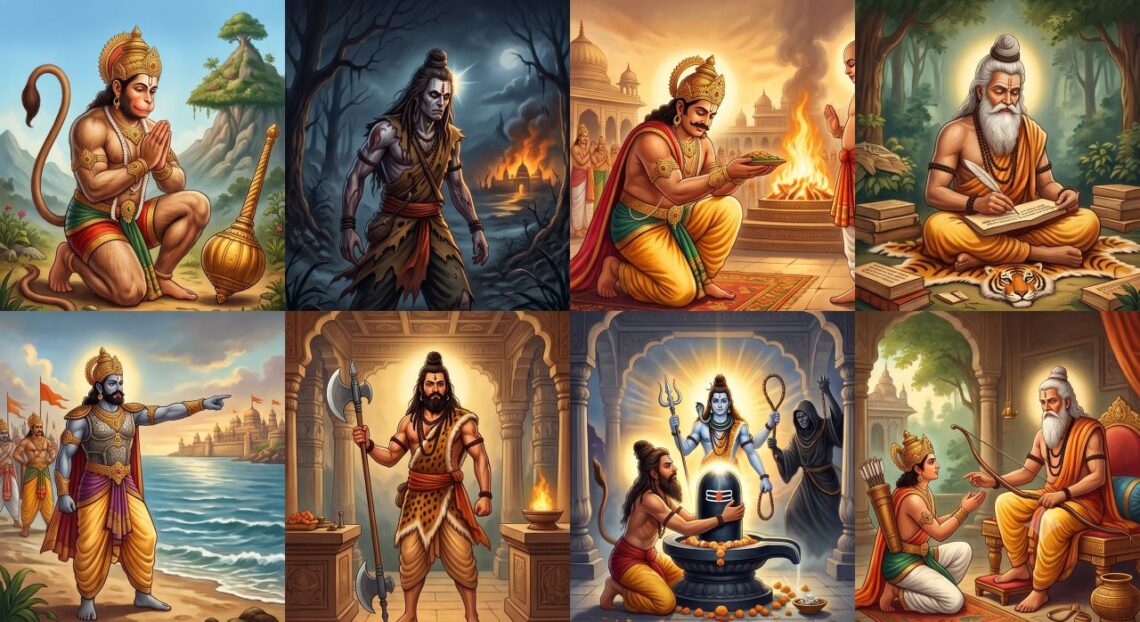
1. Hanuman – The Devotee of Infinite Strength and Devotion
Who is he?
Hanuman is the divine monkey warrior and devoted servant of Lord Rama in the Ramayana. Born to Anjana and the wind god Vayu, Hanuman is known for his boundless strength, unwavering devotion, and wisdom.
How he became immortal:
After the defeat of Ravana, Lord Rama blessed Hanuman with a unique boon:
“As long as my name is remembered, you shall live on Earth and protect those who worship me.”
Thus, Hanuman became Chiranjeevi — destined to live through all ages, inspiring devotion, courage, and service. In many temples, Hanuman is believed to be present invisibly, wherever Rama’s name is chanted.
2. Ashwatthama – The Warrior Cursed to Wander
Who is he?
Ashwatthama was the son of Dronacharya, the guru of the Pandavas and Kauravas in the Mahabharata. A fierce warrior and one of the eleven Rudras, he fought on the Kaurava side in the Kurukshetra war.
Why did he become immortal?
After the war, in a moment of rage and vengeance, Ashwatthama killed the sleeping sons of the Pandavas and tried to destroy their lineage. For this, Lord Krishna cursed him:
“You shall roam the earth, suffering from wounds that never heal, shunned by society, and without death to release you.”
Thus, Ashwatthama’s immortality is not a blessing but a curse — a life of endless remorse, pain, and isolation. His story serves as a cautionary tale about the misuse of power and unchecked anger.
3. King Mahabali – The Humble Demon King
Who is he?
Mahabali was a righteous but ambitious Asura (demon) king, known for his generosity and devotion. His rule was marked by peace and prosperity.
How he became immortal:
To test his pride and to restore cosmic balance, Lord Vishnu incarnated as Vamana, a dwarf Brahmin. Vamana asked for three steps of land. With two steps, he covered all of creation. For the third step, Mahabali offered his head.
Impressed by Mahabali’s humility and devotion, Vishnu blessed him:
“You shall rule in the netherworld (Patal Lok), and once every year, you shall return to Earth to visit your people.”
In Kerala, this return is celebrated as Onam. Mahabali lives on as a Chiranjivi, honoured for his virtue and selflessness.
4. Rishi Veda Vyasa – The Eternal Sage and Compiler of Knowledge
Who is he?
Vyasa, the son of Sage Parashara and Satyavati, is a great sage who compiled and divided the Vedas, authored the Mahabharata, and wrote the Bhagavata Purana, among other scriptures. He is regarded as an incarnation of Lord Vishnu.
How he became immortal:
As the guardian of sacred knowledge and the preserver of the Vedic tradition, Vyasa was granted the boon of immortality, enabling him to guide future generations.
It is believed he still resides in the Himalayas, continuing his spiritual work in secret.
5. Vibhishana – The Righteous Brother of Ravana
Who is he?
Vibhishana was the younger brother of Ravana in the Ramayana. While loyal to his family, he opposed Ravana’s abduction of Sita and joined Lord Rama’s side during the war.
How he became immortal:
After Ravana’s death, Rama crowned Vibhishana the king of Lanka and blessed him:
“You shall live long and rule righteously, upholding dharma.”
Vibhishana’s immortality serves as a symbol of integrity, representing a choice between righteousness and blind loyalty.
6. Parashurama – The Warrior Sage with an Axe
Who is he?
Parashurama is the sixth avatar of Lord Vishnu, born to Sage Jamadagni and Renuka. He carried an axe (parashu) given by Shiva and is known for eliminating corrupt Kshatriya rulers from the Earth 21 times.
How he became immortal:
Parashurama is said to have retired to Mount Mahendra after his divine mission. He continues to live in penance and is believed to appear again in the future to train Kalki, the tenth and final avatar of Vishnu.
As a Chiranjivi, he bridges the past and the future — the only Vishnu avatar who is still alive on Earth.
7. Rishi Markandeya – The Boy Who Defeated Death
Who is he?
Markandeya was born to a couple who had long prayed for a child. The gods gave them a choice: a wise son with a short life, or a dull son with a long one. They chose the former.
At the age of 16, when Yama (the god of death) came to take him, Markandeya clung to a Shiva Linga and prayed with full devotion. Lord Shiva appeared and struck Yama with his trident.
How he became immortal:
Moved by his devotion, Shiva granted him eternal youth and life, making him a Chiranjivi. Markandeya is also famous for his vision of cosmic dissolution and the child Vishnu lying on a banyan leaf during the Mahapralaya.
8. Kripacharya – The Teacher of Generations
Who is he?
Kripacharya, often referred to as Kripa, was the royal guru in the Mahabharata, renowned for his fairness and wisdom. He taught both Kauravas and Pandavas and remained neutral during many conflicts.
How he became immortal:
Being a balanced and dharmic teacher, Kripa was granted immortality by Krishna so that he could guide future generations and uphold learning and virtue through dark times.
He is believed to be still alive, waiting to assist the future avatar, Kalki.
The Living Legends of Dharma
The Chiranjivis are not just figures of mythology — they are symbols of eternal values:
- Hanuman — devotion and strength
- Ashwatthama — the cost of unchecked anger
- Mahabali — humility and self-sacrifice
- Vyasa — knowledge and truth
- Vibhishana — righteousness over loyalty
- Parashurama — duty and balance
- Markandeya — devotion and divine protection
- Kripacharya — wisdom and guidance
They remind us that righteousness, devotion, humility, and wisdom are timeless — and those who live by them never truly die.
Whether taken literally or symbolically, the Chiranjivis are reminders of the qualities that make life meaningful. They inspire us to live not just long, but deeply — with purpose, courage, and virtue.
Let us live like the Chiranjivis — not by seeking to live forever, but by standing for values that never die.
“Ashwatthama Balir Vyaso Hanumanshcha Vibhishanah
Kripah Parashuramascha Saptaita Chiranjivinah”
explicitly mentions seven Chiranjivis, as indicated by the word “Saptaitāḥ” (सप्तैताः) meaning “these seven”. These are the seven immortals most commonly accepted in Puranic texts.
So, why do we sometimes count eight?
The inclusion of Rishi Markandeya as the eighth Chiranjivi is a later addition or a regional/spiritual tradition-based expansion. Markandeya, though not in the classical Chiranjivi verse, is widely regarded as immortal due to:
- His devotion to Lord Shiva,
- His defeat of death (Yama) at a young age,
- His role as a witness to cosmic dissolution (Pralaya) in the Markandeya Purana.
In South Indian and Shaivite traditions, especially, Markandeya is often revered among the Chiranjivis because:
- He is blessed to remain eternally sixteen.
- He is said to transcend time, having seen multiple kalpas.
Note: Traditionally, Hindu texts mention seven Chiranjivis in the well-known Sanskrit verse. However, Markandeya is often considered the eighth due to his miraculous survival against death and his eternal youth granted by Lord Shiva. His story is especially prominent in Shaivite lore and the Markandeya Purana.