Miracles, Experience, and Consciousness as the Bridge
iv. The Ontological Argument – The Idea of God
This argument is somewhat more philosophical, yet very powerful.
Although controversial in rationalist circles, this philosophical argument posits that if one can conceive of a perfect being, it must exist—because non-existence would contradict the concept of perfection.
It says: if we can imagine a perfect being, then that being must exist. Why? Because if such a being didn’t exist, then it wouldn’t be perfect—it would be missing something (existence!). So, a truly perfect being cannot just be a dream or an idea. It must be real.
Think of the highest, most complete thing you can imagine—something that is all-knowing, all-powerful, perfectly good, and eternal. That being is what people call God. And if God is truly the greatest thing we can think of, then He cannot be just an idea in our mind—He must actually exist, or He wouldn’t be the greatest.
“If we can conceive of a perfect being, then that being must exist—because existence is part of perfection.” – because a truly perfect being cannot lack existence.
Spiritual Reflection: Saints like Sri Aurobindo noted that the soul intuitively longs for the eternal because it comes from the eternal.
Story Illustration: “The Dream of the Perfect King”
A thoughtful young prince once asked his wise teacher, “Is there truly a perfect king?”
The teacher replied, “Describe to me what a perfect king would be.”
The prince said, “He would be just, kind, fearless, and wise. He would protect the weak, lead with love, never lie, and never die. He would lack nothing—not in power, not in goodness.”
The teacher nodded, “Now imagine such a king—but imagine he does not exist.”
The prince frowned, “Then he’s not perfect. How can a perfect being be non-existent?”
The teacher smiled: “Exactly. If a perfect king is truly perfect, he must exist. Otherwise, he is missing the most important quality—real being. To be the greatest being we can think of, he cannot just be an idea. He must be real.”
Moral of the Story:
The Ontological Argument is subtle but powerful. It says: if we can truly conceive of a Being greater than anything else—who lacks nothing, who is the fullness of existence—then that Being must exist, because existence is not less than imagination, but more.
As St. Anselm, who first proposed the argument, said:
“God is that than which nothing greater can be conceived—and it is greater to exist in reality than merely in the mind.”
This idea also appears in Vedantic thought, where Brahman is not a belief or projection, but the most real, beyond thought, yet known to the soul.
v. The Argument from Miracles – Signs Beyond Nature
Miracles are events that appear to exceed the bounds of what nature can accomplish. People throughout history and around the world have witnessed events that science can’t explain—instant healings, surviving disasters without injury, visions during near-death experiences, or help appearing when all hope seems lost.
These are not everyday things, and not every miracle claim is true. However, when something clearly happens that breaks natural rules and brings about goodness or an awareness of the Divine, many perceive it as a sign from God.
Science seeks natural causes, but miracles suggest a supernatural cause, something beyond the normal laws of nature. When these events come with deep transformation, peace, or protection, they give people a strong sense that a Higher Power is at work.
“If events occur that defy natural explanation and point to a higher will, they serve as evidence of a divine power.”
Miracles and Personal Experiences
Millions testify to divine visitations, protection, and transformation through faith. From the ecstatic states of mystics like Rumi, St. Teresa of Avila, and Meera Bai, to Samadhi experiences of yogis, these states offer insights inaccessible to mere logic.
Scientific Acknowledgement: Andrew Newberg, a neuroscientist at the University of Pennsylvania, used brain scans to study monks and found altered activity in the parietal lobes—correlating with their feeling of becoming “one with the universe.”
Story Illustration: “The Man Who Was Meant to Die”
In a small mountain village in Himachal Pradesh, a man named Dev was diagnosed with a terminal illness. Doctors in Delhi gave him three months to live. His lungs were collapsing, and no known treatment was working.
Broken but not bitter, Dev returned to his village to spend his last days in peace. His mother, a deeply spiritual woman, sat by his side every day, praying with devotion at a nearby temple of Lord Shiva. She whispered daily, “If Your will is above all, save my son not for my sake—but so he may know You.”
Days turned into weeks. Dev did not die.
He began to breathe better. One month later, he was able to walk. By the third month, scans showed completely healthy lungs.
Baffled, doctors said, “We don’t have a medical explanation.”
Dev didn’t become a saint. But he changed. “I know now,” he said, “there’s something greater than science—something that listens.”
Moral of the Story:
This is not just one tale. All around the world, there are documented cases of spontaneous remission, survival against the odds, visions during near-death experiences, or miraculous rescues in moments of prayer. Although science may label them as anomalies, their impact on human hearts is real and lasting.
The Argument from Miracles suggests that these events—rare, often inexplicable, yet deeply meaningful—point toward a personal, responsive Divine Presence.
As the philosopher David Hume said (though he was sceptical):
“A miracle is a violation of the laws of nature. But… no testimony is sufficient to establish a miracle, unless the testimony be such that its falsehood would be more miraculous than the fact it endeavours to establish.”
In other words, sometimes the denial of the event is more incredible than the event itself.
vi. The Argument from Religious Experience – The Encounter with the Divine
“If millions of people across time and cultures report direct experiences of God or a higher reality, those experiences deserve serious consideration as evidence of that reality.”
This argument suggests that millions of people have had personal experiences of God or a higher reality. They may see a divine light, hear a guiding voice, experience deep peace in meditation, or even have their lives completely transformed by an inner awakening.
These aren’t just dreams or imagination, because people across cultures and religions report similar experiences, and they often transform their lives as a result. They become more compassionate, fearless, and peaceful.
Science studies the brain, but it cannot measure inner experience. Just because something is subjective doesn’t mean it’s not real. Love is also subjective—yet it’s one of the most powerful forces in life.
Spiritual traditions suggest that these experiences occur because the Divine resides within us, and sometimes, when the heart is open, that Divine Presence reveals itself.
Story Illustration: “The Blind Man Who Saw”
Rajesh was a devout but simple man, blind since birth. He lived quietly in a village in Tamil Nadu, where he helped at a local temple. He had never seen light, colour, or form, but his devotion to the divine was deep.
One day, during a festival in honour of Lord Murugan, Rajesh sat in deep prayer under a tree. For the first time in his life, he felt something indescribable—a light inside him. He later said:
“I felt as if the whole universe had turned inward—and in that vast silence, there was only love. I could not see with my eyes, but I saw something greater than sight. I met God—not outside me, but within.”
He didn’t ask for healing. He didn’t claim powers. But those who met Rajesh afterwards noticed a calm, luminous joy in him that no philosophy could explain.
Moral of the Story:
Experiences like Rajesh’s are not rare. Across the globe, from Christian mystics to Sufi saints, Buddhist monks to Bhakti yogis, millions have reported experiences of divine presence, unity, bliss, peace, and inner transformation.
Modern studies—like those by William James, Andrew Newberg, and others—have documented how genuine religious experiences often lead to:
- Lifelong ethical transformation
- Deep peace and detachment from materialism
- Selfless service and compassion
Even if subjective, these experiences are consistent across geography, language, and belief systems, pointing to a shared transcendent reality that science cannot measure—but the soul can know.
As Swami Vivekananda said:
“Religion is not in books, not in doctrines, nor in theories. It is being and becoming. It is realisation.
Spiritual Perspective: Ancient Indian scriptures speak of Aja (the Unborn) and Avyakta (the unmanifest) from which the manifest Cosmos appears.
In the Rig Veda (10.129), the question is raised poetically:
“Who truly knows, and who can declare, whence it was born and whence came this creation?” — suggesting that the source of creation may be beyond intellectual comprehension
The story of Dev given earlier of miraculous healing, echoes countless other miracle accounts: spontaneous remissions, divine protection, unexplainable outcomes. Science may call them coincidences or statistical anomalies, but to the people who live through them, they are unmistakable signs, often leaving behind transformed lives, greater faith, and deeper humility.
As spiritual teacher Neem Karoli Baba once said:
“Miracles happen not to show off power, but to show the presence of the One who is beyond all power.”
Here are some more documented events of a miracle
1. Ramana Maharshi – The Cancer That Didn’t Break His Peace
In the final years of Ramana Maharshi’s life, he was diagnosed with a painful and aggressive form of cancer. Doctors offered surgery, but he calmly refused. Despite the intense physical pain, he never showed suffering or fear.
One devotee pleaded, “Bhagavan, can’t you cure yourself?”
Ramana replied softly, “Why this fear? The body is born to die. The Self is eternal.”
Though his body grew weaker, his face radiated serenity and light. Those around him said the atmosphere near him was charged with divine presence.
The miracle: Not physical healing, but transcending pain. His peace was so profound that many who came to see him wept—not out of sorrow, but from a glimpse of something eternal.
2. Sai Baba of Shirdi – The Leaking Oil Lamp
Local shopkeepers once refused to give oil for lamps at the Shirdi mosque. Sai Baba, calm and undisturbed, filled the lamps with plain water and lit them anyway.
To everyone’s shock, the lamps burned bright with no oil.
The same shopkeepers later bowed to him, ashamed of their doubt.
The miracle: Transforming water to fire—not to impress, but to show that faith and surrender unlock a higher law beyond material limitation.
3. Neem Karoli Baba – The Train That Waited
In 1935, a young Neem Karoli Baba was thrown off a train at a small station in Uttar Pradesh for not having a ticket. The train wouldn’t start again, despite all technical checks. Eventually, the railway staff pleaded with the baba to re-board. As soon as he stepped back in, the train moved.
The miracle: Machines responded to a conscious presence. Even the British officer in charge became his lifelong devotee.
4. Anandamayi Ma – The Unburnt Saree
Once, Anandamayi Ma was deep in meditation when a small fire broke out near her, and her saree caught fire. Despite the flames touching her body, she did not move. The cloth was charred, but her skin remained completely unharmed.
The miracle: Her body seemed unaffected by fire, as if her awareness was beyond physical limits.
What Do These Stories Show?
These miracles are not stage acts or displays of ego. They are gentle disruptions of natural law, revealing that behind the seen world lies an unseen intelligence that responds to love, faith, and purity.
As Swami Vivekananda said:
“The highest manifestation of strength is to keep ourselves calm and on our own feet.”
These saints did that—even when nature itself stood still around them.
Consciousness: The Missing Link Between Science and God
Neuroscience has mapped regions of the brain responsible for memory, decision-making, and emotion—but not for subjective experience itself. Consciousness does not seem to be in the brain, but rather uses the brain. Consciousness is the one thing we experience directly, but cannot measure externally.
Quantum Theories like Orch-OR (by Roger Penrose and Stuart Hameroff) propose that consciousness arises from quantum processes in microtubules within neurons—an interface of the non-local and physical.
Spiritual Understanding: Consciousness is the “knower” of all experiences. As Mahavakya says: “Tat Tvam Asi”—You are That (consciousness itself).
In Nijanand, the Supreme is not a concept to believe in, but a transcendent Conscious Power—“Aksharateet”—the Supreme Lord – beyond even the causal realms of Akshar and Kshar.
As Adi Shankaracharya said: “Chidananda Rupah Shivoham Shivoham”—I am of the nature of Consciousness and Bliss. I am Shiva.
Science and Spirituality: Two Eyes to See the Whole
The truest understanding arises when we stop pitting science and spirituality against each other. Each offers insight into different dimensions of existence. Let us not see science and spirituality as opposing forces, but as complementary lenses.
| Science | Spirituality |
| Studies the physical universe | Explores the inner universe |
| Relies on evidence and logic | Relies on experience and realisation |
| Seeks prediction and control | Seeks transcendence and unity |
| Works with the measurable | Engages with the immeasurable and eternal |
| Builds technology | Builds inner transformation |
| Seeks “how it works” | Asks “why it exists” |
Scientific Wisdom:
“The most beautiful thing we can experience is the mysterious. It is the source of all true art and science.” — Albert Einstein
Spiritual Wisdom:
“That which cannot be seen with the eyes, but because of which the eyes see… know That alone to be Brahman.” — Kena Upanishad
Conclusion: Beyond Equations Lies the Eternal
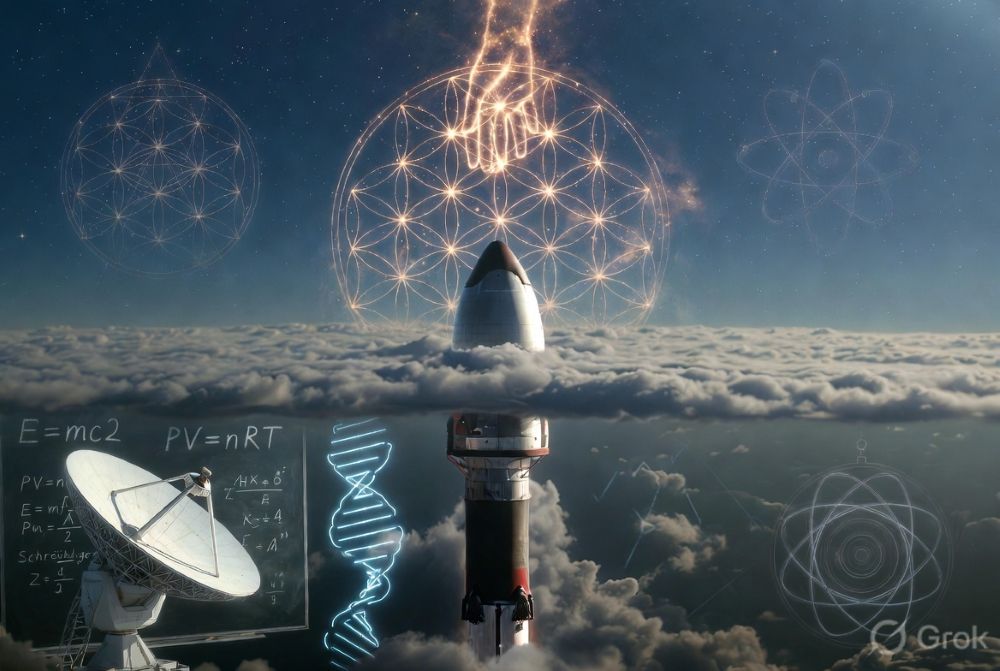
Science shines a powerful light into the structure of the universe. But structure is not origin, and mechanism is not meaning. When we face the deepest questions—“Who am I?”, “Why am I here?”, “What happens when I die?”—Science respectfully steps aside. This is where spirituality steps in.
Spiritual traditions do not claim to replace science. Rather, they complement it by illuminating the source, the seer, and the supreme consciousness that science cannot measure.
Einstein put it aptly:
“Science without religion is lame, religion without science is blind.”
The path ahead is not conflict but integration—a harmony of outer exploration and inner realisation.
“When science stops at the threshold of matter,
Spirituality begins with the call of the soul.”
Let this be our compass—where logic ends, love begins; where formulas fail, faith awakens; and where the cosmos ends, consciousness remains.
When science stops at the threshold of matter,
Spirituality begins with the call of the soul.
Where equations fall silent and senses shatter,
The heart remembers what once made it whole.