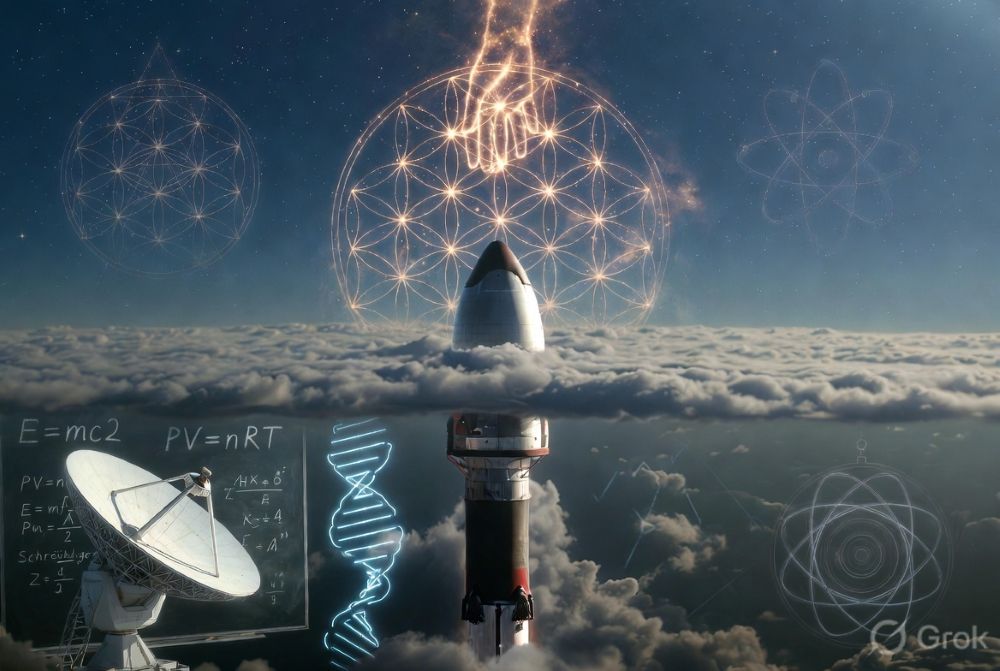
Spiritual Arguments and the Case for Divine Intelligence
Spiritual Insight: Saints across traditions have performed acts that transcend the domain of natural laws—not to violate them, but to reveal the existence of higher laws. In the Bhagavad Gita, Krishna says, “I am the miracle among the miraculous.”
Spiritual Arguments for a Divine Intelligence
Over centuries, spiritual philosophers have offered powerful reasons why belief in God or a higher intelligence is not irrational, but profoundly insightful.
Spiritual traditions, unlike science, embrace subjectivity as a valid domain of inquiry. Through meditation, introspection, and divine communion, seekers across the ages have uncovered insights that seem to point to an intelligent, conscious source behind all existence.
i. The Cosmological Argument – The First Cause
Premise: Everything that begins to exist has a cause; the universe began to exist; therefore, it has a cause. This cause must be uncaused, timeless, immaterial, and powerful—attributes often associated with the Divine.
Scientific View: The Kalam Cosmological Argument, revived by contemporary philosopher William Lane Craig, asserts:
“Whatever begins to exist has a cause; the universe began to exist; therefore, it has a cause.”
The Kalam Cosmological Argument is a modern version of a classical philosophical argument for the existence of God, primarily advocating that the universe has a cause—and that cause must be a transcendent, personal Creator.
Form of the Argument (Simple Syllogism)
- Whatever begins to exist has a cause.
- The universe began to exist.
- Therefore, the universe has a cause.
Historical Origins
- The argument has Islamic philosophical roots, particularly in the medieval Kalam school of Islamic theology, hence the name “Kalam Cosmological Argument.”
- It was later developed and popularised in the 20th century by Christian philosopher William Lane Craig, who used it to argue for a theistic God.
Explanation of Each Premise
1. Whatever begins to exist has a cause
- This is based on the principle of causality: things don’t just pop into existence from nothing.
- If something begins to exist, there must be something (or someone) that caused it.
2. The universe began to exist
- Scientific support:
- Big Bang theory: The universe had a finite beginning about 13.8 billion years ago.
- Second Law of Thermodynamics: The universe is running out of usable energy, implying it hasn’t existed forever.
- Philosophical support:
- Infinite regress of past events is considered logically and mathematically problematic (e.g., Hilbert’s Hotel paradox).
3. Therefore, the universe has a cause
- If the universe had a beginning, then it must have a cause that is outside of it—i.e., not bound by time, space, or matter.
- This cause must be:
- Uncaused (otherwise, you have infinite regress)
- Timeless
- Immaterial
- Powerful
- Personal (to choose to create a temporal world)
These attributes align closely with the theistic conception of God.
Criticism of the Argument
- Quantum mechanics: Some argue particles appear without cause, though others contest this interpretation.
- Cause-and-effect might be meaningless “before” time began, since time itself began with the Big Bang.
- Not necessarily God: Even if there is a cause, critics say it doesn’t have to be the God of any religion.
Spiritual Insight
The Kalam Argument offers a bridge between scientific cosmology and metaphysical inquiry. For Vedantic and non-dual traditions, the uncaused cause is not just a God who creates from outside—but Consciousness Itself, from which even time and space emerge.
Science can explain physical processes that occurred after the universe appeared, but it remains silent on what caused the beginning.
Spiritual Angle: Vedanta speaks of the Anadi (beginningless) cause—Brahman, beyond time and causality, from which time-space emerges.
The Bhagavad Gita says, “I am the source of all spiritual and material worlds. Everything emanates from Me” (10.8).
ii. The Teleological Argument – Intelligent Design
“The universe displays such order, precision, and purpose that it must have been designed by an intelligent mind.”
The universe appears to be finely tuned for the existence of life. From DNA to the gravitational constant, the level of precision is astounding.
This argument suggests that the universe is so beautifully arranged, purposeful, and finely balanced that it couldn’t have occurred by chance. It looks designed, like something that came from a brilliant mind.
Think about it: the Earth is the right distance from the sun. Water possesses the ideal properties to support life. Our lungs are perfectly designed to extract oxygen from the air. DNA works like a detailed instruction manual in every living cell. The laws of physics—like gravity, magnetism, and motion—are precisely tuned to make life possible.
Could all of this order, complexity, and purpose have come from random explosions or blind processes? Many, including me, believe it’s more reasonable to say that there was an intelligent designer—something or someone that shaped the universe with intention and care.
Even many scientists agree that the mathematical precision behind the physical laws suggests a deeper intelligence. Nobel Prize-winning physicist Paul Dirac once said, “God is a mathematician of a very high order.”
In short, when we see design, we naturally assume a designer.
Scientific Example: The fine-tuning of physical constants—like the gravitational constant or the cosmological constant—is so precise that a minuscule deviation would make life impossible. Even physicist Paul Davies admits this uncanny precision seems intentional.
Spiritual Insight: The intricate interdependence seen in nature (e.g., the bee-flower pollination system, the Fibonacci sequence in plants, the golden ratio in galaxies) has long been viewed by mystics as the signature of divine harmony.
The universe appears to be finely tuned for the existence of life. From DNA to the gravitational constant, the level of precision is astounding.
Scientific Example: The fine-tuning of physical constants—like the gravitational constant or the cosmological constant—is so precise that a minuscule deviation would make life impossible. Even physicist Paul Davies admits this uncanny precision seems intentional.
Spiritual Insight: The intricate interdependence seen in nature (e.g., the bee-flower pollination system, the Fibonacci sequence in plants, the golden ratio in galaxies) has long been viewed by mystics as the signature of divine harmony.
Story Illustration: “The Watch in the Desert”
A traveller is crossing a vast desert alone. After days of walking, he finds a beautifully crafted watch lying on the sand. Intrigued, he picks it up. The second hand ticks perfectly, the gears inside spin in sync, and the numbers are neatly arranged.
He wonders, “Who made this? Surely it didn’t assemble itself out here.”
Another traveller nearby says, “Oh, don’t be silly. The wind just blew metal and glass around until it formed this.”
The first traveller laughs. “That’s impossible! The precision, the purpose—this clearly has a maker.”
Then he pauses, looks at the setting sun, the stars above, his own hand… and realises:
“If I believe the watch must have a maker because of its design, how can I believe the universe—far more complex—doesn’t?”
Moral of the Story:
A simple watch shows design and purpose—therefore, it has a maker. The fine-tuning of the universe, from gravitational constants to DNA code, is far more intricate. The Teleological Argument points to the presence of an intelligent Designer, not by blind faith, but by the evidence of structured beauty and harmony everywhere.
As Sir Isaac Newton once said:
“The most beautiful system of the sun, planets, and comets could only proceed from the counsel and dominion of an intelligent and powerful being.”
As the Isha Upanishad declares:
“He who sees all beings in the Self and the Self in all beings, never turns away from it.”
This interconnectedness reflects not randomness, but intentional harmony.
iii. The Moral Argument – The Inner Law
This argument suggests that within every human being lies a profound sense of right and wrong. We all feel that honesty is good, and hurting others without reason is wrong—even if we’re never taught that. We feel guilty when we lie, and we admire people who do the right thing, even when it’s hard.
Science can study how people behave, or how morals might have helped early humans survive. But it can’t explain why we feel a strong inner pull to be good, even when it’s not useful or rewarded.
Where does this “moral voice” come from?
Spiritual thinkers say this voice is the whisper of a higher power, the consciousness within us, a reflective bit of the Cosmic/Universal consciousness—a divine source of goodness. Just like a compass points north, the human heart points toward truth, justice, and compassion. That inner guidance, they say, reflects the presence of God’s law written in the soul.
Throughout history and across cultures, humans have shared a common sense of right and wrong. We admire honesty, kindness, and courage, and we condemn cruelty, theft, and betrayal. Even when no one is watching, many people feel guilty about lying or hurting others. This inner sense of morality appears to be built into our very being.
But where does this moral compass come from?
“There exists within every human an inner sense of right and wrong that points to a higher moral source.”
Scientific Challenge:
Science Explains Some, But Not All
Evolutionary biology suggests that moral behaviour evolved because it enables humans to survive as social beings. Traits such as cooperation, empathy, and fairness facilitate peaceful coexistence within groups, facilitate the raising of offspring, and promote mutual protection. But why should humans feel guilt when no one is watching? Why is there a universal reverence for truth and compassion?
Yes, evolution may explain why people cooperate, because societies that help one another tend to survive better. But evolution doesn’t fully explain:
However, this explanation has limits:
If morality were only a survival strategy, we might expect it to vary widely depending on what helps each group thrive. But instead, we find a consistent inner moral law—a deep sense that some things are inherently good or evil.
- Why do people help strangers at personal cost? Why do people sometimes choose to do the right thing even when it costs them personally, like risking their life to save a stranger
- Why do we feel shame or guilt in secret? Why do we feel guilt or shame even in private, when no one else knows what we’ve done?
- Why moral truths seem universal—like truth is good, and cruelty is bad. Why do moral values (like justice and honesty) appear universal, even among people in very different cultures and eras?
If morality were just a product of survival, it would be relative and self-serving. However, many people often sacrifice comfort, wealth, or even their lives for the sake of truth, justice, or compassion.
Spiritual Perspective:
Spiritual traditions suggest that this inner moral compass isn’t just a product of evolution—it’s a reflection of a higher, divine law written into the human soul. Spirituality says that this moral voice is not just human—it reflects the presence of a higher moral order, or Divine Law. In every soul, there’s a spark of the Divine that remembers what is true, even when the world tempts otherwise.
As Mahatma Gandhi said:
“The still small voice within me tells me that I must not fear to do what is right.”
- In the Bhagavad Gita, Lord Krishna calls this inner guide the “Dharma”—the path of righteousness that every soul must follow.
- In Christianity, it’s called “natural law”, meaning a moral sense placed in humans by God.
- In the Taittiriya Upanishad, morality is considered a reflection of Rta, the cosmic moral order that underlies both the universe and the human heart.
Saints like Kabir and Sri Ramakrishna emphasised that true dharma arises not from fear of consequence, but from inner alignment with the divine.
This argument suggests that the very presence of morality points to a Moral Source—a conscious intelligence (God) that grounds these values not in survival, but in Truth.
In Simpler Terms:
If someone does something wrong when no one else knows—and still feels bad about it—where does that feeling come from?
It’s not fear of punishment. It’s not biology. It’s something deeper: a whisper from the soul—an inner reminder that we are accountable not just to society, but to a higher presence or truth.
Story Illustration: “The Stolen Exam Paper”
In a college hostel, two roommates, Neha and Aarti, are preparing for a difficult final exam. One night, Neha finds an envelope mistakenly left in a professor’s bag—a copy of the upcoming test paper.
Aarti is asleep. Neha opens it. She now has a choice: use it and score well, or walk away.
She hesitates. No one will know. She could ace the exam. Her career would be secure.
But something in her heart stirs. A silent unease. A whisper: “You didn’t earn this.”
She closes the envelope, returns it anonymously the next morning, and sits for the test—with a clear conscience.
Later, she says, “Even if the whole world says yes, if my inner voice says no—I must listen to that.”
Moral of the Story:
That inner voice—the conscience—isn’t learned from textbooks or enforced by law. It arises from within. It guides, accuses, and encourages. Even in isolation, it speaks.
The Moral Argument – Another Story
Imagine this:
A man named Ravi is walking down a quiet road late at night. There’s no one around. He notices a wallet lying on the ground. He picks it up and finds it filled with cash, credit cards, and an ID card.
No cameras. No witnesses. No one would ever know if he kept the money.
Ravi hesitates. For a moment, he thinks, “I could use this. No one will find out.”
But something inside him speaks louder than greed. A quiet voice within says, “This is not yours. You must return it.”
So, Ravi takes a detour, finds the address on the ID, and returns the wallet. The owner is overwhelmed with gratitude.
When Ravi walks away, he feels a deep peace—not because someone praised him, but because he did what was right.
What Does This Tell Us?
- Why did Ravi feel that returning the wallet was the right thing to do, even when he could have kept it without consequence?
- Why did he feel inner peace afterwards—not from praise, but from integrity?
This inner sense of right and wrong—even when no one is watching—is what the Moral Argument is all about.
Science can explain behaviour, but not moral compulsion. Why do we feel guilty in secret? Why sacrifice ourselves for strangers? The Moral Argument says: such a moral law implies a Moral Lawgiver—a higher Being from whom this deep ethical intuition flows.
As C.S. Lewis wrote:
“If there were a controlling power outside the universe, it could not show itself to us as one of the facts inside the universe—yet it could influence us from the inside, as a voice of conscience.”