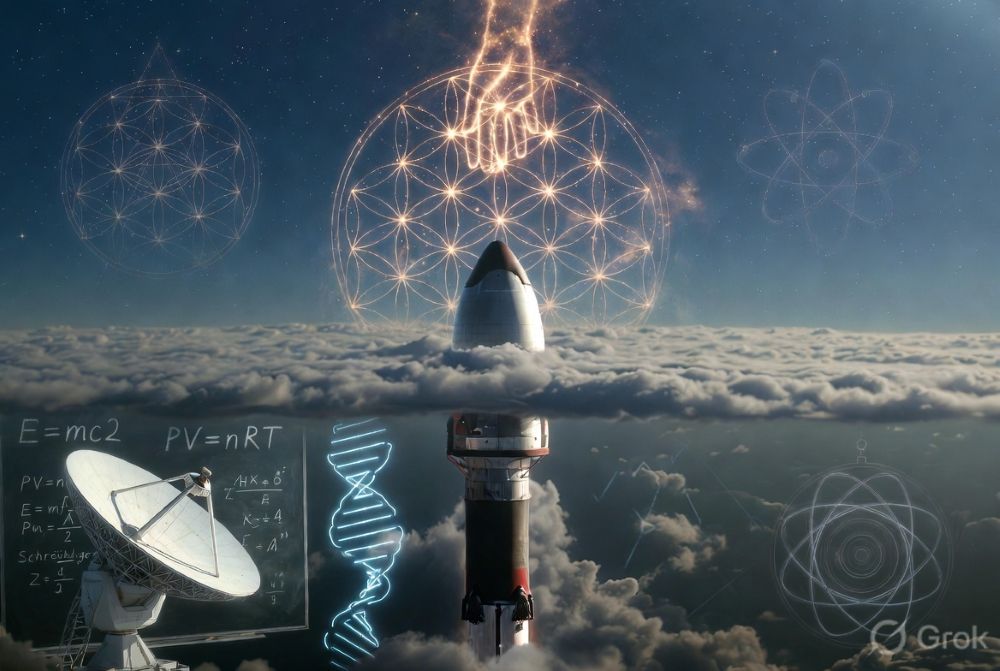
Where Science Ends and the Search for Meaning Begins
In an era where science reaches the stars and probes the depths of atoms, many assume that all truth must come from laboratories, equations, and telescopes. Yet, a subtle but compelling question wrangles human thought: Is there a God? This question is not merely a throwback from old traditions—it emerges from the deepest human curiosity and longing to understand the “why” behind the “what.”
While science is a magnificent human ally for uncovering the mechanics of the universe, it often finds itself silent—or at best, uncertain—when it comes to matters beyond material form, such as consciousness, purpose, morality, emotions, thoughts, the origin of everything, and the possibility of life beyond death. Spirituality, on the other hand, dares to reach into these realms. Let’s explore where science ends and spirituality begins, and whether the concept of a Divine Intelligence remains relevant in a science-dominated world.
The Limits of Science: What It Can and Cannot Explain
Science is the study of how things work. It relies on observation, replication, and quantification. But there are limits to what can be observed: Science—based on measurable evidence and repeatable experimentation—is the crowning glory of the modern intellectual world. It has cured diseases, split atoms, landed spacecraft on Mars, and digitised human communication. But for all its triumphs, it encounters boundaries and limits.
The Beginning of the Universe
The Big Bang Theory, now widely accepted, posits that the universe* began as a singularity nearly 13.8 billion years ago. But what preceded the Big Bang? What caused the singularity? Some scientists, such as Stephen Hawking, have proposed models involving imaginary time or quantum fluctuations, where space and time become indistinguishable. Yet, even these models do not answer the ultimate question: why the universe exists, or for that matter, why anything exists at all.
*It is to be understood that the universe that Science refers to is our universe, which is just one microcosmic unit of the infinite number of universes that exist. What manifested from the so-called singularity is the Cosmos that took shape much earlier, as early as 155 trillion years, within which Universes appear and disappear with multitudes of big bangs.
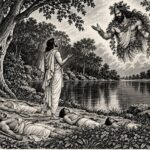
Story Illustration: The Falling Apple and the Unseen Hand: A young boy named Arjun is lying under a tree on a windy afternoon. As he daydreams, an apple falls beside him. Curious, he asks his grandfather, “Why did the apple fall?” His grandfather smiles, “Because the wind shook the branch.” “But why was there wind?” Arjun presses. “The air moved because of temperature differences,” the grandfather replies. “And what caused that?” Soon, Arjun’s questions lead back through sunlight, Earth’s rotation, gravity, and finally—“But where did all this come from?” His grandfather, now thoughtful, says, “Every effect has a cause. But if we keep asking what caused what, eventually we must ask—what started it all? There must be something that didn’t need to be caused—something outside the chain.” That cause, many believe, is God.”
Moral of the Story:
Arjun’s childlike questions reflect a deep truth: if everything has a cause, then the universe itself must have a cause. But that cause cannot itself be caused—otherwise, we’re stuck in an infinite loop. Therefore, the first uncaused cause must lie outside time, space, and matter—a reality that spiritual traditions refer to as God or the Supreme Consciousness.
In the Rig Veda (10.129), the question is beautifully framed:
“Who truly knows, and who can declare, whence it was born and whence came this creation?”
Consciousness
We can scan brain activity, map neurons, and describe psychological processes. However, the experience of awareness —the inner self that watches, feels, and chooses—remains beyond the reach of microscopes. Consciousness is not matter. It’s a subtle, non-physical reality that eludes reductionist science.
Despite breakthroughs in neuroscience, cognitive psychology, and AI, consciousness remains an enigma. How can matter give rise to awareness? Studies, such as the Hard Problem of Consciousness (David Chalmers), highlight that while we can measure brain activity, we cannot explain subjective experience. In fact, they highlight the difference between the neural correlates of consciousness and consciousness itself, which cannot be explained as mere electrochemical activity.
Experiments in quantum physics, particularly the observer effect in the double-slit experiment, suggest a participatory role of consciousness in shaping reality.
Spiritual Viewpoint: Upanishadic wisdom asserts, “Prajñānam Brahma”—Consciousness is Brahman. Consciousness is not a product of matter; rather, matter emerges within the field of consciousness.
Nijanand Sampradaya and other non-dual schools assert that consciousness is the eternal substratum—the divine observer of all phenomena.
Miracles and Anomalies
Across the world, people report spontaneous healings, near-death experiences (NDEs), past-life memories (including cases verified by children who recall past lives), and other extraordinary events. These are often dismissed as outliers, yet they point to a realm beyond what science can verify, but cannot completely deny.
Science depends on reproducibility; however, documented cases of miraculous events, such as spontaneous remission in terminal illnesses, documented near-death experiences (NDEs), and verified cases of reincarnation (as studied by Dr. Ian Stevenson and Dr. Jim Tucker at the University of Virginia), remain scientifically inexplicable and suggest that not everything fits within the framework of natural law.
In India, the case of Shanti Devi (1930s), who recalled her past life in astonishing detail, was investigated and verified by a committee appointed by Mahatma Gandhi.
Story Illustration: The Man Who Was Meant to Die: In a small mountain village in Himachal Pradesh, a man named Dev was diagnosed with a terminal illness. Doctors in Delhi gave him three months to live. His lungs were collapsing, and no known treatment was working. Broken but not bitter, Dev returned to his village to spend his last days in peace. His mother, a deeply spiritual woman, sat by his side every day, praying with devotion at a nearby temple of Lord Shiva. She whispered daily, “If Your will is above all, save my son not for my sake—but so he may know You.”
Days turned into weeks. Dev did not die. He began to breathe better. One month later, he could walk. By the third month, scans showed completely healthy lungs. Baffled, doctors said, “We don’t have a medical explanation.”
Dev didn’t become a saint. But he changed. “I know now,” he said, “there’s something greater than science—something that listens.
This event was not unique—but part of a larger pattern of phenomena that science cannot fully explain
Moral of the Story:
This is not just one tale. All around the world, there are documented cases of spontaneous remission, survival against the odds, visions during near-death experiences, or miraculous rescues in moments of prayer. Although science may label them as anomalies, their impact on human hearts is real and lasting.
The Argument from Miracles suggests that these events—rare, often inexplicable, yet deeply meaningful—point toward a personal, responsive Divine Presence.
As the philosopher David Hume said (though he was sceptical):
“A miracle is a violation of the laws of nature. But… no testimony is sufficient to establish a miracle, unless the testimony be such that its falsehood would be more miraculous than the fact it endeavours to establish.”
In other words, sometimes the denial of the event is more incredible than the event itself.