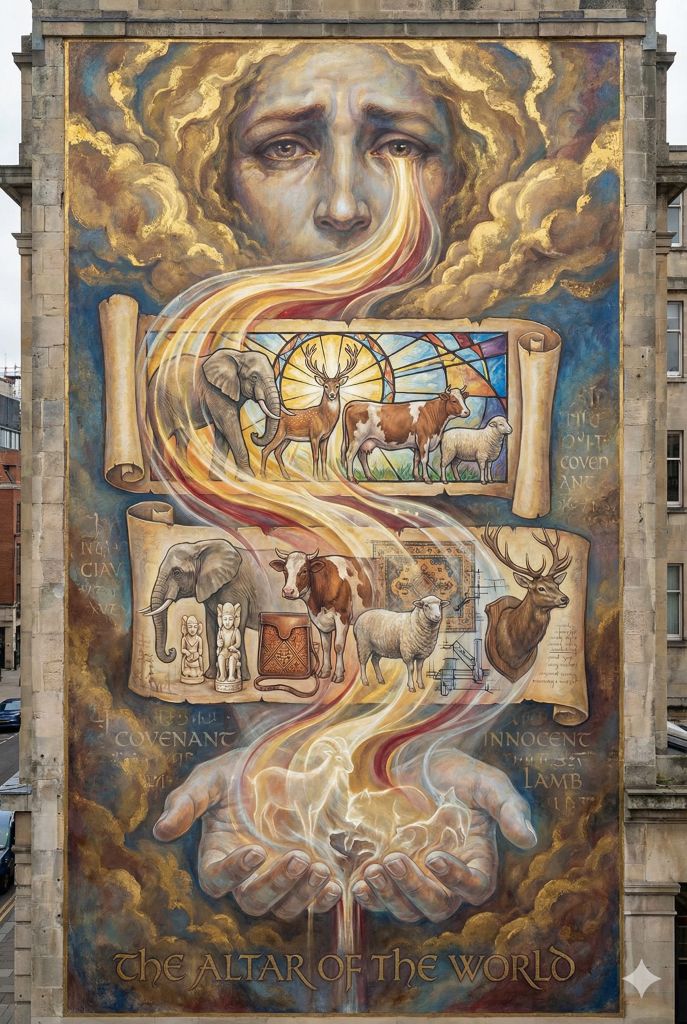
O’ human, with a drawn sword in hand!
Before you sever the head of the innocent, helpless, and dumb animal, stop for a moment. Ask yourself: What exactly are you going to achieve by this act? What reward do you expect by shedding the blood of a being that has never harmed you? Do you think the Universal Mother, before whom you sacrifice this life, smiles upon cruelty?
If She is the mother of all creation, is She not also the mother of the trembling animal tied at your feet? If She gave breath to you, did She not also breathe life into that voiceless creature?
If you don’t have the power to give life, what right do you have to take it?
1. A Misunderstood Tradition
Animal sacrifice is often excused as a ritual inherited from ancient times. But the word yajña in the Vedas did not mean the slaughter of animals. It meant noble offering — acts done in selflessness, charity, and truth. The fire of yajña was meant to purify, not to burn flesh.
“Ahimsa Paramo Dharmaḥ”
– Mahabharata, Anushasana ParvaTranslation:
Nonviolence is the highest religion.
Even in the oldest scriptures, symbolic language was used. Only later did misunderstanding and misinterpretation turn rituals into acts of horror.
2. Ask the Goddess Herself: Does She Need Blood?
If the goddess you worship is Shakti, the Mother, the giver of life, the nurturer of the universe, does it make sense that she rejoices in pain and blood?
Would any mother be pleased to see one of her children tortured to please another?
Real shakti is nurturing, not destroying.
The divine feminine energy is healing, not harming.
3. If God Is Everywhere, Then the Victim, Too, Is God
You bow to the idol and chant sacred names, but the animal you sacrifice is also God’s creation. If divinity is in all, then God resides in the animal too.
“I am the Self seated in the hearts of all creatures.”
Bhagavad Gita 10:20
Killing God’s manifestation in front of another form of God is not worship. It is a contradiction.
4. Would You Offer Your Own Child?
When a person ties down a goat or a buffalo to “offer” it to a deity, let them ask themselves one honest question:
Would I do the same if it were my own child?
If the answer is no—and it always is—then know this: that creature, too, has a mother. That animal, too, feels fear, longing, and pain. Your willingness to cause pain, while shielding your own, is not devotion, but selective compassion, and selective compassion is not spiritual elevation.
5. If You Can’t Kill Your Child, Don’t Kill Another’s
Would you offer your own child to a deity? Of course not. Then remember: every calf, every goat, every hen has a mother. The pain of losing one’s offspring is the same for all beings.
“He who sees the pain and joy of others as his own is a true yogi.”
Gita 6:32
True religion is about expanding your circle of empathy, not narrowing it with tradition.
6. What the Great Souls Taught
- Lord Buddha stopped kings from performing bloody rituals.
- Mahavira preached total nonviolence, even toward insects.
- Guru Nanak questioned the logic of offering blood to God.
- Swami Vivekananda said: *”You have just enough religion to hate, but not enough to love.”
No prophet, no enlightened being, ever encouraged the killing of the innocent.
“Where there is compassion, God dwells.”
7. If God Is Everywhere, Then the Victim, Too, Is God
You bow before the deity with folded hands and ask for blessings. But the animal you sacrifice is also a creation of God. If you believe “God is omnipresent,” then He is as much in the animal you are about to kill as in the idol you are praying to.
By sacrificing a living being in front of an idol, you are killing the divine before the divine.
8. Reverence Isn’t Just For Gods—It’s for Life
You garland a stone, bathe a statue in milk, and light lamps before it.
But the living, breathing animal next to you—who is also a marvel of divine engineering—you tie, beat, and kill?
This is not worship. This is spiritual hypocrisy.
If you truly honour the sacred, begin with honouring life itself.
9. Scientific Truth: Animals Feel Like Us
Modern science confirms that animals are sentient. They feel pain, joy, loneliness, and fear. They suffer when separated from their young. Studies show cows mourn, elephants grieve, and goats remember kindness.
We share 90% of our DNA with many animals. Our brains are wired similarly to process pain. To claim they don’t feel is a form of ignorance.
A heart that bleeds at human suffering but not at animal suffering is half-awake.
10. The Karmic Trap: Violence Is Never Free
Every action, especially one involving life and death, returns to the doer.
The law of karma is impartial. When you take a life, even under the name of religion or ritual, you are binding yourself to a karmic debt. That animal’s silent pain does not vanish; it echoes in your destiny, your health, your peace of mind, your family, and perhaps even your next birth.
Do not create a chain of suffering around your soul in the name of devotion.
11. Karma Doesn’t Discriminate
Every action you take returns to you. Killing an animal, directly or indirectly, creates karma — a weight on your soul.
“As you sow, so shall you reap.”
– Galatians 6:7
“Na hinasti bhūtāni”
– Yajurveda 36.18Translation:
Do not harm living beings.
You may not suffer immediately. But pain returns in unseen ways: illness, unrest, fear, rebirth in suffering
12. The Meat Illusion: Taste Over Life
For meat-eaters, here is a question: Is the brief pleasure of taste worth the lifelong suffering of a living being?
Meat-eating is no longer a necessity. It is indulgence. When we have rich, plant-based alternatives, why cause harm for a few seconds of flavour?
“Nothing will benefit human health and increase chances of survival on Earth as much as the evolution to a vegetarian diet.”
– Albert Einstein.
13. Animal Instinct vs. Human Conscience
A tiger kills out of necessity to survive. A snake bites in defence when threatened. But humans have a conscience. We are endowed with intelligence, morality, and the capacity to make choices. How, then, do we kill in the name of culture, entertainment, and rituals
To choose cruelty when kindness is available is to fall below the animal. Ask yourself: Are you behaving like a thinking human, or acting worse than a beast?
The difference between man and animal is not intelligence, but conscience. Use it. The mark of a higher being is not just intelligence — it is moral awareness.
14. What If Rituals Are Meant to Evolve?
Rituals emerged in an era when human understanding was limited, and symbolic acts were employed to convey devotion. But in the age of knowledge and compassion, is it not time to question and evolve?
Just as we no longer burn widows, or believe the Earth is flat, we must also let go of outdated practices that involve pain and blood.
Spiritual maturity means growth, not blind repetition.
15. Worship Through Life, Not Death
Spirituality is not about lighting lamps before idols and lighting fire under animals.
Real worship is feeding the hungry, saving a life, and showing mercy.
“Let all beings be happy. Let all beings be free of suffering.”
– Shanti Mantra.
Let your next offering be this: I vow not to harm. I vow to protect.
16. What If the Roles Were Reversed?
The animal bleeds in silence. It cannot cry for justice. But what if the roles were reversed?
Imagine being tied. Imagine the blade approaching. Imagine your breath being taken in the name of someone’s ritual.
Would you still call it holy?
17. The Silence of the Innocents Will Someday Speak
Every creature you kill or harm stays silent—because it cannot speak your language. But the universe keeps account.
That cry-the last bleat, the frightened eyes, the panic of a bound animal—does not disappear. It vibrates in the unseen layers of reality and will one day return in a form you may not recognise.
What you do to others, you ultimately do to yourself.
18. A Meat-Eater’s Reflection: What’s the Real Cost of Taste?
Those who eat meat must also ask: Is momentary pleasure on the tongue worth the lifelong suffering of a living being?
You would never want to be treated the way the animals in slaughterhouses are treated.
Why then support an industry of systematic torture and death, just for flavour?
In a world of abundant plant-based food, the meat habit is not need—it is indulgence. And indulgence at the cost of another’s life is a form of violence.
19. What Enlightened Souls Taught Us
- Lord Mahavira walked barefoot, sweeping the path before him to avoid stepping on an insect.
- Gautam Buddha stopped a king from performing a sacrifice, saying, “No being deserves to die for your merit.”
- Guru Nanak taught that compassion is the highest virtue.
None of them endorsed animal killing. Their message was clear: to evolve spiritually is to expand your circle of compassion
20. The True Offering in This Age
This age demands a new yajña:
- Sacrifice your ego
- Sacrifice your cruelty
- Sacrifice your outdated customs
“The highest yajña is that of wisdom.”
– Gita 4:33
Let your hands rise in prayer, not in slaughter. Let your faith be seen in your mercy, not in blood.
21. End animal sacrifice. Begin true worship.
Let the future remember that in this time, we rose beyond tradition and chose compassion over cruelty.
“Jeevo Karuna Eeshwar Bhakti Hai.”
Translation:
Compassion for all life is true devotion to God.