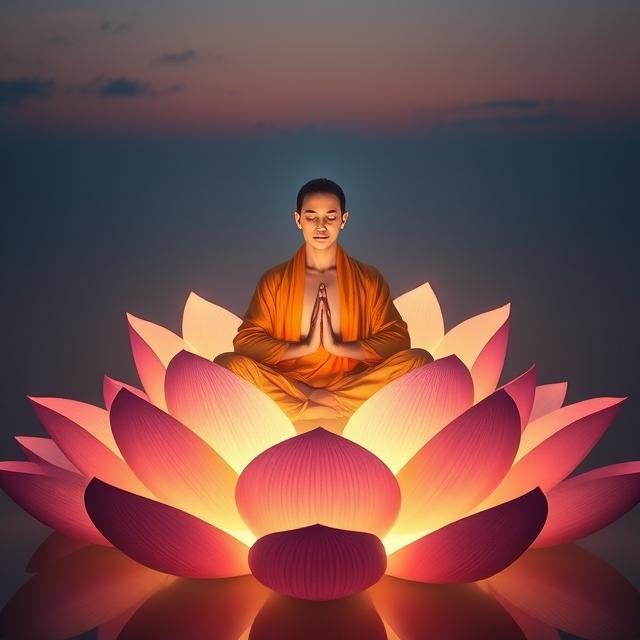
Understanding the Concept of Vairagya
Non-attachment, or detachment (vairagya), is a profound concept revered across spiritual traditions—be it Hinduism, Buddhism, Jainism, or mystic branches of other world religions. It entails living without becoming enslaved to anything, akin to a lotus leaf floating untouched on the waters of life. Just as the lotus rises above the muddy pond to bloom unstained, the spiritual seeker is advised to live in the world without being tainted by it.
Detachment is not a passive avoidance of life’s challenges. Rather, it is an active cultivation of equanimity, clarity, and self-awareness. As Lord Krishna says in the Bhagavadgita (2.48),
“Yogasthaḥ kuru karmāṇi saṅgaṁ tyaktvā dhanañjaya; siddhy-asiddhyoḥ samo bhūtvā samatvaṁ yoga ucyate.”
“Be steadfast in yoga, O Arjuna. Perform your duty and abandon all attachment to success or failure. Such evenness of mind is called yoga.”
Attachment: The Subtle Bondage of the Soul
Attachment binds us to the sensory world, limiting our vision, knowledge, and awareness. It spawns desires, which, when unfulfilled, lead to anger and suffering. This chain reaction is vividly described in the Bhagavadgita (2.62–63):
“From attachment arises desire, from desire arises anger. From anger comes delusion; from delusion, loss of memory; from loss of memory, destruction of intellect; and from the destruction of intellect, one perishes.”
This cycle of craving and aversion keeps us caught in samsara, the cycle of birth and death, which hinders our spiritual evolution and obscures our true Self.
The Buddhist Perspective: Craving and the End of Suffering
In Buddhism, attachment (upādāna) is identified as the root cause of suffering (dukkha). The craving for pleasure and the aversion to pain trap us in a cycle of discontent, preventing us from fully experiencing the present moment. The Buddha emphasized this in the Second Noble Truth:
“It is this craving which leads to renewed existence…accompanied by delight and lust, seeking delight here and there.”
In this view, freedom from attachment is achieved through mindfulness, insight, and the Eightfold Path, culminating in nirvāṇa, the cessation of all clinging.
Hindu View: Performing Duties Without Attachment
The Bhagavadgita offers a powerful model of non-attachment through karma yoga—the path of selfless action. It attributes deluded behaviour to attachment, noting that our fixation on sense objects and desires influences our actions, binding us to the cycle of karma.
True liberation (moksha) comes not by escaping the world but by remaining fully engaged—performing our duties with devotion, yet without any desire for their fruits.
As Krishna instructs:
“Karmanye vadhikaraste ma phaleshu kadachana; ma karmaphalaheturbhurma te sangostvakarmani.”
“You have a right to perform your prescribed duties, but you are not entitled to the fruits of your actions.”
This insight transforms worldly action into a sacred offering, freeing us from bondage while allowing us to live fully.
Jain Insight: Non-Possessiveness and Self-Discipline
In Jainism, detachment is closely linked to the principle of aparigraha (non-possessiveness). The Jain sages practised rigorous self-restraint, understanding that every attachment—even mental or emotional—strengthens the ego and binds the soul to karmic layers.
As the Tattvartha Sutra states,
“Samyagdarśanajñānacāritrāṇi mokṣamārgaḥ” —
“Right faith, right knowledge, and right conduct constitute the path to liberation.”
Thus, detachment is essential to purify the soul and move toward eternal bliss.
Attachments: The Many Faces of Bondage
Attachments come in various forms—physical, emotional, mental, and even spiritual—and shape our identities, desires, and behaviors. We may be attached to people, memories, beliefs, outcomes, or even our spiritual progress. Each attachment forms a subtle chain, limiting our freedom, joy, and spontaneity.
Whether it is a relationship we cannot release, an idea we are unwilling to question, or a result we crave, these attachments perpetuate individual and collective suffering.
As Sri Ramakrishna beautifully said,
“Live like a mudfish. It lives in the mud but its body remains spotless.”
Cultivating Detachment: The Inner Practice
To achieve freedom from attachment, we must cultivate non-attachment through mindfulness, meditation, discernment (viveka), and surrender (śaraṇāgati). By letting go of our likes, dislikes, and preferences, we open ourselves to the possibility of unconditional joy and liberation.
Detachment does not imply indifference or cold withdrawal. Rather, it entails being fully present and engaged in life, but without egoic entanglement in the outcomes.
Sri Aurobindo said:
“Detachment is the first condition of effective sincerity. One must be prepared to lose everything in order to gain the All.”
The Fruit of Detachment: Inner Freedom and Joy
Living in the present moment, free from fear and judgment, allows us to experience true joy, fulfilment, and compassion. When we act without the shadow of expectation, our hearts are lighter, our relationships purer, and our minds clearer.
This is the essence of vairagya—not abandonment, but freedom. Not suppression, but transcendence. It is the way of the lotus, the way of the wise, the path that leads from bondage to immortality (amṛtatva).
Postscript: The Spirit of Detachment Across Traditions – A Semitic Reflection
Though non-attachment (vairagya) is most commonly emphasised in Indian spiritual traditions—such as Hinduism, Buddhism, and Jainism—the principle finds deep resonance in the Semitic faiths as well: Judaism, Christianity, and Islam. While these religions may not always use the same terminology, they uphold the inner spirit of detachment: not as indifference or renunciation of life, but as alignment with the Divine will, contentment in simplicity, and freedom from egoic grasping.
Judaism: Trusting Without Clinging
In Judaism, spiritual maturity involves trusting God’s plan and not clinging to temporal realities. The concept of bitachon (trust in God) teaches that one’s inner security must arise from the Eternal, not from wealth, status, or outcomes.
Rabbi Bahya ibn Paquda, in Duties of the Heart, urges:
“Do not let your heart be attached to the possessions of this world, for you are merely a visitor upon the earth.”
This trust naturally breeds detachment, for the heart knows it rests in something greater than the ever-changing world. True wisdom, as found in the Book of Ecclesiastes, understands that all earthly striving is “vanity” (hevel), unless rooted in reverence for God.
Christianity: Surrendering the Self to the Divine
In Christianity, Jesus Christ exhorted followers to detach from possessions and ego to follow a higher calling.
“For what will it profit a man if he gains the whole world, yet forfeits his soul?”
(Matthew 16:26)
True discipleship requires letting go of attachments—whether to wealth, comfort, or reputation—and cultivating humility, charity, and surrender. Saint Francis of Assisi lived in joyful poverty, declaring,
“It is in giving that we receive.”
Even amidst suffering, the Christian ideal is to remain inwardly free, saying with St. Paul:
“I have learned to be content whatever the circumstances… I can do all things through Christ who strengthens me.”
(Philippians 4:11-13)
Islam: Living Lightly With Tawakkul and Zuhd
Islam articulates non-attachment through tawakkul (trust in Allah) and zuhd (detachment from worldly indulgence). The Prophet Muhammad lived a simple life and taught his followers to live as travellers in this world, passing through without clinging to it.
The Qur’an reminds:
“The life of this world is but play and amusement… but the Hereafter is better for those who are mindful of God.”
(Surah Al-An’am 6:32)
Sufi mystics went deeper, affirming that love for the Divine purifies the heart of all other attachments. As Rumi wrote:
“Don’t grieve. Anything you lose comes round in another form.”
This mirrors the Hindu sentiment of nashvarata—impermanence—and atmabhava—returning to the Self or Divine Source.
A Universal Path to Inner Freedom
Though cultures and doctrines differ, the essence of non-attachment is universal:
- To live without being possessed by what we possess.
- To love without clinging.
- To act with devotion, not for result.
- To move through the world with lightness, inwardly anchored in the Eternal.
Whether spoken as vairagya, bitachon, tawakkul, or kenosis (emptying of the self), the call is the same:
Let go, and return to what never leaves.
Summing Up:
The Blooming Lotus Within
Let the lotus be our symbol.
Rooted in the muddy waters of life, it reaches upward, blossoming in pristine beauty. So too must we live in the world, rooted in reality, grounded in duty, yet untouched by its binding grasp.
As the Mundaka Upanishad proclaims:
“He who knows the Supreme Brahman becomes the Supreme. None can surpass him; he becomes free, free from all bonds.”
This is the call of detachment—not to leave the world behind, but to live in it with clarity, love, and liberation.